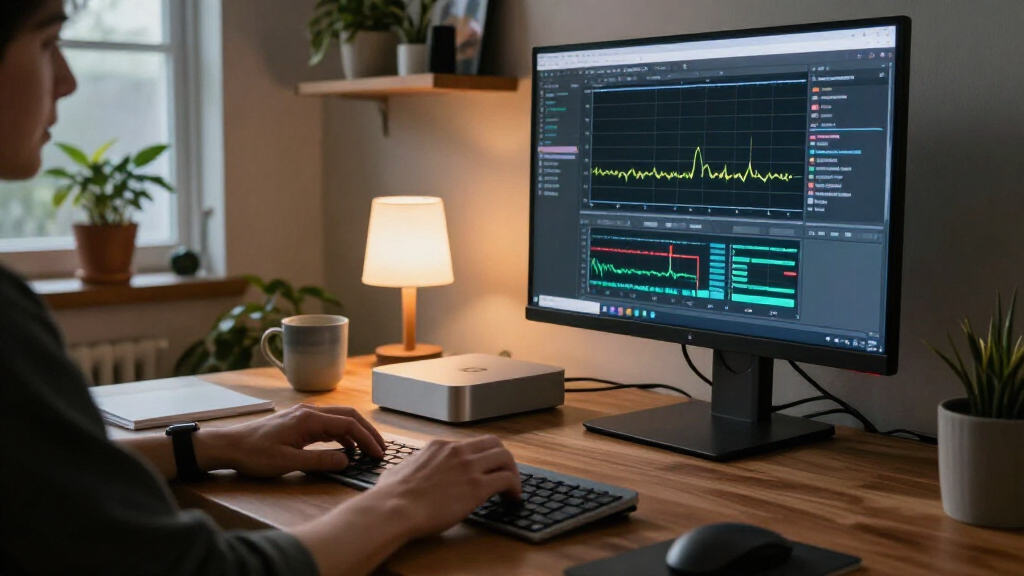

🔍 Read the full analysis: Local AI On A Mac Mini: Picking The Right Amount Of Memory on ThorstenMeyerAI.com

Get business pricing on office and shipping supplies
- Business-only prices and quantity discounts
- Tax-exempt purchasing
- Multiple users, one account, clear invoices
TL;DR
Apple now positions the Mac mini as a desktop for always-on AI agents, with configurations offering 16GB to 64GB of unified memory. Published model requirements suggest smaller and mid-size open models can fit, but system use, long context and model precision affect the practical limits; larger models still need more memory and faster hardware.
Apple is pitching the Mac mini as a desktop for always-on AI agents, and its current configurations offer 16GB to 64GB of unified memory. Published requirements from Google and OpenAI indicate that some open models can run within those limits, but the usable model size depends on memory left for macOS, apps and conversation context, as well as the model’s precision.
Apple’s August 25 announcement described the Mac mini as “the leading desktop for always-on agentic computing”, according to the source report. At U.S. list prices checked November 16, the lineup starts at $899 for a 16GB M6 model and reaches $3,199 for a 64GB M5 Pro configuration. Memory is selected when ordering and cannot be treated as a separate pool reserved entirely for a model.
Google’s published Gemma 4 figures offer a comparison. Its 31-billion-parameter model needs about 17.5GB at 4-bit precision and 34.9GB at 8-bit; at 16-bit, the cited requirement is 69.9GB. That suggests the 4-bit version may fit on a 32GB Mac mini, while the 8-bit version is a candidate for the 64GB model. These are model-weight estimates, not guarantees of smooth operation.
Google says its figures cover static model weights only; larger context windows need additional memory. Apple silicon’s unified memory lets the CPU and GPU access the same pool, but macOS and other applications use that pool too. Lower precision reduces memory needs, though it can affect output quality. The practical choice is therefore not simply the model’s listed size: it also depends on how much memory remains available during use.
Memory Sets the Local AI Ceiling
The memory choice can determine whether a model runs locally at all, and whether it has room to handle longer prompts. For buyers planning to keep a Mac mini for AI work, more unified memory offers flexibility, but the source figures do not show that every model that technically fits will run quickly or leave enough room for other tasks.
Local operation can appeal to people seeking to keep prompts and documents on their own machine, work offline, or avoid usage-based cloud charges. Those benefits depend on the software and setup, and do not by themselves establish that local processing is cheaper overall. Apple also cited low idle power as a fit for an always-on computer; the source reports an idle figure of about 4 watts, but does not provide independent testing conditions.
Speed is another limit. Apple lists memory bandwidth of 153–170GB/s for M6 and 307GB/s for M5 Pro. Nvidia lists 3.35TB/s for its H100 SXM GPU, around 11 times the M5 Pro figure by simple division. That comparison concerns bandwidth, not a direct benchmark of model response times; it does, however, show why fitting a model does not mean matching data-center hardware.
Popular right now

Dyson Airstrait Styling Brush

KitchenAid Commercial Series 8-Quart Bowl-Lift Stand Mixer, White

Dyson V9 Motorbar Cordless Vacuum
As an affiliate, we earn on qualifying purchases.
Apple’s Agent-Computing Pitch
The Mac mini’s AI positioning follows rising interest in running models on personal computers. The source reports that Apple described demand for the Mac mini and Mac Studio as arriving faster than expected during its April 30 earnings call. Tim Cook said, “Both of these are amazing platforms for AI and agentic tools”, according to MacRumors.
For the Mac mini, the hardware distinction is unified memory. Apple’s MLX documentation says the CPU and GPU have direct access to the same pool, unlike a typical PC arrangement in which a graphics card has separate memory. That shared pool can let the GPU access more of the system’s memory for model weights, but it is still shared with the operating system and applications.
The cited model examples span different sizes. OpenAI says gpt-oss-20b runs “within 16GB of memory”, while its gpt-oss-120b is sized for a single 80GB GPU. The source says Apple points to Thunderbolt 5 clustering multiple Mac minis as an on-device approach for larger models. That is a different scale and setup from buying one standard Mac mini.
““Both of these are amazing platforms for AI and agentic tools and the customer recognition of that is happening faster than what we had predicted.””
— Tim Cook, on Apple’s April 30 earnings call, according to MacRumors
Fit Does Not Guarantee Performance
The cited memory requirements do not establish real-world performance for every Mac mini configuration. The source provides no standardized response-time or throughput tests, and results can vary with model software, quantization, prompt length and other applications running at the same time. Google specifically warns that longer context windows need additional memory.
It is also unclear how well Apple’s proposed Thunderbolt 5 clustering performs for particular models or what extra hardware and setup it requires. The supplied material gives no comparative cost analysis of local hardware against cloud services, and no independent confirmation of the reported idle-power figure. Model fit, speed, output quality and total cost should not be treated as interchangeable measures.
Check Requirements Before Ordering
Anyone choosing a Mac mini for local AI should compare the exact model version and precision they intend to use with the computer’s memory, then leave headroom for the operating system, other apps and context. Google’s model documentation and OpenAI’s published requirements provide starting points, not a substitute for testing the intended workflow on the actual configuration.
Apple’s current lineup and U.S. prices can change, and model requirements may shift as developers publish new versions or software optimizations. Buyers considering larger models will need to watch for detailed performance information about multi-Mac clustering and compare that setup with cloud or workstation alternatives. The source material does not identify a specific forthcoming test or product milestone.
Key Questions
Can a 16GB Mac mini run local AI models?
Published figures indicate that some smaller models can fit: OpenAI says gpt-oss-20b runs within 16GB, and Google’s Gemma 4 12B needs 6.7GB at 4-bit precision. Those figures do not include all system and context use, so fitting does not guarantee performance in every setup.
Is 32GB enough for Gemma 4 31B?
Google lists about 17.5GB for Gemma 4 31B at 4-bit precision, which is below 32GB. The computer also needs memory for macOS, apps and context, so available headroom matters. At 8-bit, the cited requirement is 34.9GB.
What does unified memory mean for local AI?
Apple says its CPU and GPU can access the same memory pool. That lets the GPU use system memory for model weights, but the pool is shared with macOS and applications rather than being wholly reserved for AI.
Can a 64GB Mac mini run the largest models?
Not all of them. The source says OpenAI sizes gpt-oss-120b for a single 80GB GPU, which exceeds the Mac mini’s maximum 64GB. Apple has pointed to Thunderbolt 5 clustering multiple Mac minis, but the supplied material does not give performance results for that approach.
Will a local Mac mini be as fast as a cloud GPU?
The available bandwidth figures suggest a substantial hardware gap: Apple’s M5 Pro is listed at 307GB/s, while Nvidia’s H100 SXM is listed at 3.35TB/s. That is a bandwidth comparison, not a direct speed test, so exact response times for a given model remain unclear.
Source: ThorstenMeyerAI.com