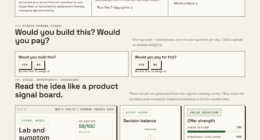
📊 Full opportunity report: Readiness: Before You Fund The Answer on ThorstenMeyerAI.com — validation score, market gap, and execution plan.

Get business pricing on office and shipping supplies
- Business-only prices and quantity discounts
- Tax-exempt purchasing
- Multiple users, one account, clear invoices
TL;DR
A new readiness diagnostic provides organizations with a quick, 20-minute evaluation before AI deployment. It helps identify potential failure modes tailored to different business types, aiming to prevent costly mistakes.
A new diagnostic assessment called Readiness is now available to organizations considering AI deployment. It provides a quick, 20-minute evaluation to determine whether their AI systems are prepared to deliver value or risk failure, helping prevent costly mistakes before investment.
The Readiness tool offers a structured assessment that classifies organizations into categories such as not ready, premature, pilot, or scale, providing a clear verdict for decision-makers. It evaluates the organization’s specific context, including data maturity, regulatory constraints, and operational structure, and offers tailored insights.
Unlike traditional evaluations, this diagnostic emphasizes actionable outputs: a percentile ranking against peers, identification of specific failure modes linked to the organization’s business type, and a concrete plan of three immediate actions. It relies solely on a corporate email and takes about twenty minutes, with no login or passwords required.
Developed based on insights into how AI failures often go unnoticed until they cause significant damage, the tool aims to give organizations a quick, honest check before committing resources to AI projects. It also emphasizes that the assessment is independent and non-sales-oriented, designed solely to inform internal decision-making.
Before You Fund the Answer
Most world-model AI implementations look clean for a year, then decision quality erodes where no dashboard can see it. Twenty minutes and a corporate email tell you — before you sign — whether the money will compound or quietly evaporate.
A clear tier framed in language a CFO will accept — plus your percentile against peers in your sector and size band, so a score becomes a position you can take to the board.
+ twenty minutes
- No follow-up machine — no vendor in your inbox next week.
- No “book a call.” The output is an action you can take without it.
- No vendor scorecard. It doesn’t sell the implementation it assesses.
- No thumb on the scale toward “you’re ready, let’s talk.”
- Subtraction, pointed at a decision. Strip the vendor theater and dashboard-green comfort until the few things that decide success are visible.
- Independence is the product. A diagnostic that deletes your email has nothing to gain from any verdict but the true one — including “not ready.”
- The shift it’s built for. AI is moving from describing to predicting and acting; readiness is a question you answer before deployment, not during it.
- Find out before you fund the answer. The only thing more expensive than this assessment is learning the answer the slow way.
Independent commentary, produced with AI assistance under human editorial oversight. The views are the author’s own and may change. Readiness is a diagnostic tool, not business, financial, legal, or technical advice; its verdict is one input, not a substitute for due diligence. Regulatory references are named as examples, not legal guidance. Product, model, and company names are trademarks of their respective owners; mention does not imply endorsement.
Why Pre-Deployment Readiness Checks Are Critical for AI Success
As AI systems become more decision-making and embedded in business operations, the risk of subtle failures increases. Organizations that skip early assessments often discover too late that their AI systems are eroding value or misaligning with operational realities. The Readiness tool aims to prevent these costly missteps by providing a quick, honest snapshot of organizational preparedness, saving time and money and improving deployment outcomes.
AI deployment readiness assessment tool
As an affiliate, we earn on qualifying purchases.
As an affiliate, we earn on qualifying purchases.
The Growing Need for AI Deployment Readiness Evaluation
Most failed AI implementations do not show immediate signs of failure; instead, issues emerge gradually over months or quarters as decision quality erodes without clear warning. Experts highlight that the shift from descriptive AI to world-model AI—systems that predict and act—amplifies the importance of readiness assessments. These systems can confidently make decisions that appear correct but are subtly wrong, leading to long-term damage.
Traditional evaluation methods often occur too late, after deployment, when feedback loops are slow and expensive. The Readiness assessment addresses this gap by offering a rapid, pre-deployment check that identifies specific failure modes tailored to different business types, including data-rich, regulated, and document-driven organizations.
“Most organizations discover their AI failures only after significant investment and time have been spent. The Readiness diagnostic offers a quick, cost-effective way to catch issues early.”
— Thorsten Meyer, AI expert
business AI risk evaluation software
As an affiliate, we earn on qualifying purchases.
As an affiliate, we earn on qualifying purchases.
Unanswered Questions About the Diagnostic’s Effectiveness
While the diagnostic has shown promising results in early trials, it is not yet clear how accurately it predicts long-term AI deployment success across diverse industries. Its effectiveness in real-world, complex scenarios remains under evaluation, and there is limited data on how organizations respond to its recommendations.
AI project failure prevention diagnostic
As an affiliate, we earn on qualifying purchases.
As an affiliate, we earn on qualifying purchases.
Next Steps for Adoption and Validation of the Readiness Tool
The developers plan to expand pilot programs with a broader range of organizations and collect data on deployment outcomes. They also intend to refine the assessment criteria based on user feedback and real-world results. Widespread availability is expected within the next few months, with organizations encouraged to incorporate the diagnostic into their initial AI planning processes.
organizational AI maturity evaluation
As an affiliate, we earn on qualifying purchases.
As an affiliate, we earn on qualifying purchases.
Key Questions
Can the diagnostic predict all types of AI failures?
No, it is designed to identify specific failure modes related to organizational context, but it cannot predict every possible failure or long-term outcome.
Is the assessment suitable for all industries?
The tool is tailored to different business types, including data-rich, regulated, and document-driven organizations, but its accuracy may vary depending on industry specifics.
How does the diagnostic deliver its verdict?
It provides a clear classification (not ready, premature, pilot, or scale), a percentile ranking against peers, and a set of three concrete actions tailored to the organization’s weakest area.
Is there a cost to use the diagnostic?
No, the assessment is offered free of charge in exchange for a corporate email address, with no login or passwords required.
Source: ThorstenMeyerAI.com
Fall Picks
fall essentials
As an affiliate, we earn on qualifying purchases.