
📊 Full opportunity report: The Eye Over The City: How Wide-Area Motion Imagery Works — And Where It Goes Blind on ThorstenMeyerAI.com — validation score, market gap, and execution plan.
TL;DR
Wide-Area Motion Imagery (WAMI) allows authorities to monitor entire cities simultaneously, tracking all moving objects. This technology’s capabilities and limitations are shaping future surveillance practices, with ongoing integration of AI and sensor fusion.
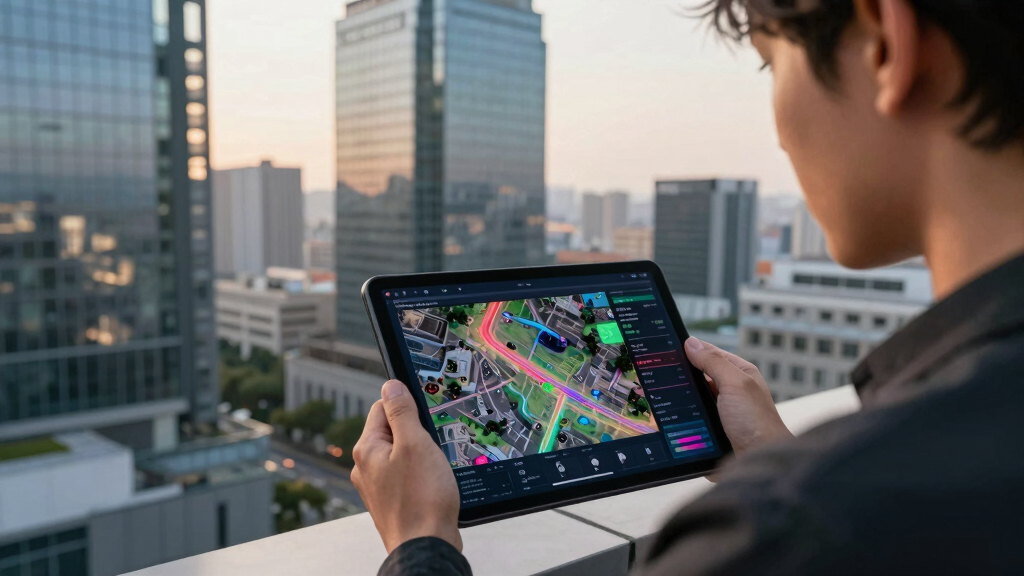
Wide-Area Motion Imagery (WAMI) is transforming urban surveillance by enabling authorities to monitor entire cities in a single frame, tracking every vehicle and pedestrian across several square kilometers. This technology, used by military and civilian agencies, combines high-resolution imaging with extensive archiving capabilities, allowing analysts to rewind and investigate past movements. Its deployment is expanding, driven by advances in sensor technology and artificial intelligence, raising significant questions about privacy and governance.
WAMI systems utilize large arrays of cameras stitched into a single composite image, capturing gigapixel-scale visuals from platforms such as aircraft, drones, and tethered aerostats. For example, DARPA’s ARGUS-IS employs 368 cameras to produce approximately 1.8 gigapixels, capable of resolving objects as small as six inches from 17,500 feet altitude, effectively providing a city-wide ‘firehose’ of real-time data. This imagery is processed through sophisticated pipelines that stabilize, detect movement, track objects, and archive footage for future analysis.
Deployment history traces back to the early 2000s with the Sonoma Persistent Surveillance Program, evolving through systems like the Army’s Constant Hawk and the Air Force’s Gorgon Stare, which was used on Reaper drones in Afghanistan. Today, WAMI is employed for military intelligence, border security, wildfire mapping, and disaster response, often complementing other sensors like radar. However, its reliance on optical imaging makes it vulnerable to weather, darkness, and contested airspace, necessitating integration with radar systems like SAR to overcome these limitations.
The eye over the city: how Wide-Area Motion Imagery works — and where it goes blind
A normal drone sees through a soda straw. WAMI watches an entire city at once, tracks every mover, and records it all for forensic rewind. Immense reach — with hard limits that make radar and AI its necessary partners.
- City-scale motion, fine detail
- Forensic rewind
- Cloud / smoke / dark degrade it
- Needs a platform loitering overhead
sensing
+ AI
- Sees through cloud & total dark
- Tasked over denied airspace
- Persistent, wide-area from orbit
- Sovereign · on-prem · air-gap
The same archive that traces a bomber to a safe house can trace anyone home — retroactively, without prior suspicion. Baltimore’s secret 2016 deployment led to a 2021 federal ruling that persistent aerial tracking violated the Fourth Amendment. The security value is real; so is the mass-surveillance risk. Who owns the sensor, the archive, and the AI is the accountability question.
WAMI’s power is the archive and the AI reading it; its weakness is weather, airspace, and oversight. The mature posture isn’t optical-vs-radar or capability-vs-liberty — it’s layered sensing (optical WAMI + all-weather SAR), AI-enabled exploitation, and sovereign, auditable control of the whole chain. WAMI shows what a persistent eye can do with clear skies and owned airspace; for the cloud, the night, and the denied area, the radar layer is where the resilient coverage lives.
Impacts of WAMI on Urban Surveillance and Security
WAMI technology significantly enhances the ability of authorities to conduct persistent, comprehensive surveillance of urban environments. Its capacity for detailed, retrospective analysis supports crime investigation, border control, and disaster management, potentially transforming public safety and security protocols. However, this raises critical governance and privacy concerns, especially regarding the extent of surveillance and data retention, which are already being challenged in courts.
high resolution city surveillance camera
As an affiliate, we earn on qualifying purchases.
As an affiliate, we earn on qualifying purchases.
Evolution and Current Use of Wide-Area Motion Imagery
WAMI originated in military research labs in the early 2000s, with the Sonoma Persistent Surveillance Program at Lawrence Livermore National Laboratory pioneering its development. Transitioning to defense applications, the technology was deployed in Iraq with the Army’s Constant Hawk system and later adapted for drone-based platforms like the Reaper, where it provided continuous city-wide monitoring. Its capabilities have expanded into civilian sectors, including wildfire mapping and disaster response, reflecting a broader trend of integrating surveillance tech into national security and emergency management.
“WAMI systems are like city-sized cameras that can rewind time, revealing movements and origins of every vehicle and person within their coverage.”
— Thorsten Meyer, expert in surveillance tech
gigapixel wide-area motion imagery system
As an affiliate, we earn on qualifying purchases.
As an affiliate, we earn on qualifying purchases.
Limitations and Challenges of WAMI Technology
While WAMI provides extensive coverage, it faces significant limitations: it relies on optical sensors that are hindered by weather, darkness, and atmospheric conditions, and it requires platforms to loiter within physical reach of targets, which can be contested or denied in hostile environments. Additionally, the massive data rates and processing demands make real-time monitoring impractical without automation and AI, raising questions about scalability and oversight. The integration with radar systems like SAR is promising but still evolving, and the legal and ethical implications of such pervasive surveillance are actively debated.
As an affiliate, we earn on qualifying purchases.
Future Developments in WAMI and Sensor Fusion
Advances are expected in AI-driven automation to better analyze and filter the vast data streams generated by WAMI systems. The continued integration of optical imagery with synthetic aperture radar (SAR) will address weather and darkness limitations, enabling truly persistent, all-weather surveillance. Additionally, developments in smaller, more affordable sensors and platforms may expand deployment to tactical units and civilian agencies, prompting ongoing legal and policy discussions about privacy, oversight, and governance.
As an affiliate, we earn on qualifying purchases.
Key Questions
How does WAMI differ from traditional surveillance cameras?
WAMI captures a city-wide, gigapixel image in real time, tracking all movement across several square kilometers, unlike traditional cameras which focus on narrow fields of view and lack retrospective analysis capabilities.
What are the main limitations of WAMI?
Its effectiveness is limited by weather, darkness, and contested airspace, and it requires platforms to loiter overhead. The enormous data rates also necessitate automation and AI for practical use.
How is WAMI used outside military applications?
It is employed for wildfire mapping, disaster response, border security, and infrastructure monitoring, providing broad situational awareness in civilian contexts.
Will WAMI replace other surveillance methods?
No, it complements systems like radar and full-motion video, filling specific coverage and forensic niches that other sensors cannot.
What legal or ethical issues are associated with WAMI?
Concerns include privacy invasion, data retention, and government oversight, leading to ongoing legal challenges and policy debates about its use.
Source: ThorstenMeyerAI.com