
TL;DR
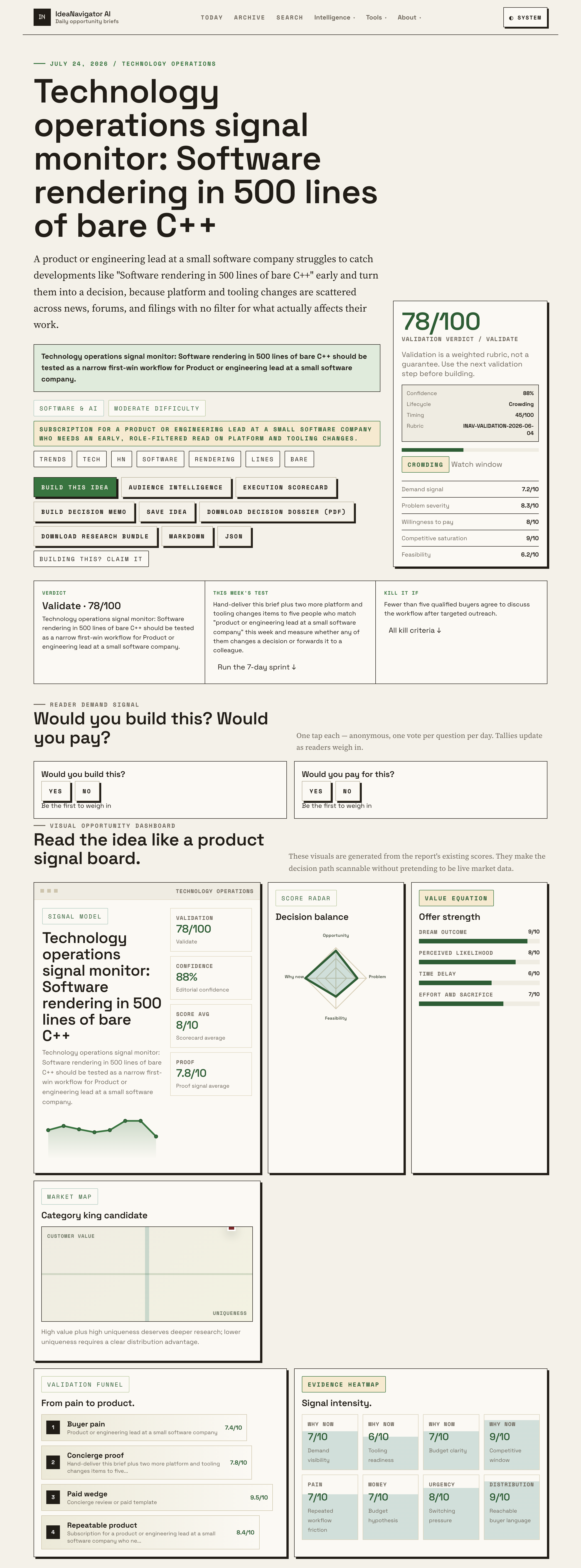
A small software team has developed a signal monitoring tool in just 500 lines of C++, enabling rapid detection of platform and tooling changes. This approach aims to help product and engineering leads respond quickly to relevant updates.
A new signal monitoring tool, written in just 500 lines of bare C++, has been developed to help small software teams quickly detect relevant platform and tooling changes. Designed for product and engineering leads, this minimal tool aims to streamline decision-making amid rapid technological updates, according to recent reports.

Get business pricing on office and shipping supplies
- Business-only prices and quantity discounts
- Tax-exempt purchasing
- Multiple users, one account, clear invoices
The tool was created as a focused monitor that scans feeds like Hacker News, filtering for updates that impact small software companies. It condenses relevant information—such as the development of ‘software rendering in 500 lines of bare C++’—into concise briefs, highlighting what has changed and why it matters.
Developers and product managers at small firms often struggle to stay on top of scattered news, forum discussions, and filings about platform and tooling updates. This tool aims to address that gap by providing role-filtered, immediate alerts, enabling faster responses and better decision-making.
Implications for Small Software Teams’ Decision-Making
This lightweight monitoring approach could significantly improve how small teams respond to rapid platform changes. By reducing information overload and focusing on relevant, high-signal updates, it allows teams to act quickly, potentially gaining a competitive edge or avoiding disruptions caused by unnoticed updates.
Furthermore, its minimal codebase—just 500 lines of C++—demonstrates that effective monitoring does not require complex, resource-heavy solutions, making it accessible for small organizations with limited development resources.
Popular right now

Dyson Car+Boat Cordless Handheld Vacuum

Ninja Foodi 10-Qt DualZone Smart XL Air Fryer, 6-in-1, Black (DZ550)

Roborock Qrevo 2 Pro Robot Vacuum and Mop with 20,000 Pa Suction
As an affiliate, we earn on qualifying purchases.
Rapid Rise of Role-Specific Monitoring Tools
In recent years, the volume and velocity of platform and tooling updates have increased, driven by faster development cycles and more frequent releases. Existing monitoring solutions are often too broad or too complex for small teams, leading to delays or missed opportunities.
The recent surge in signals like the ‘software rendering in 500 lines of bare C++’ showcases a trend toward minimal, role-specific tools designed to meet the needs of product and engineering leads, who require quick, filtered insights rather than comprehensive dashboards.
“This 500-line C++ tool is a game-changer for small teams needing quick, reliable signals about platform changes.”
— an anonymous developer
Unclear Scope and Adoption Potential
It is not yet clear how widely this tool will be adopted or whether it can scale beyond initial testing. The effectiveness of the filtering algorithms and its ability to keep pace with rapidly evolving platforms remain to be validated through broader deployment.
Further development may be needed to integrate with existing workflows and tools used by small teams, and its long-term impact on decision-making is still uncertain.
Next Steps for Development and Deployment
Developers plan to expand testing among small organizations to assess real-world effectiveness. Feedback from early users will guide improvements, including better filtering accuracy and integration options. The creators aim to establish a subscription model targeting product and engineering leads who need role-filtered signals, with plans to monitor adoption and impact over the coming months.
Key Questions
How does this tool differ from existing monitoring solutions?
This tool is designed to be extremely lightweight, with only 500 lines of C++, focusing solely on role-relevant signals from feeds like Hacker News. Unlike more comprehensive solutions, it emphasizes speed, simplicity, and targeted filtering for small teams.
Can this tool be customized for different types of platform updates?
Yes, the filtering algorithms can be tailored to specific feeds or update types, allowing teams to prioritize the signals most relevant to their projects and workflows.
Is this tool suitable for large organizations?
Currently, it is aimed at small software teams. Larger organizations may require more comprehensive, scalable solutions, but the core concept could be adapted for broader use.
What are the technical requirements to run this monitor?
The tool requires a minimal C++ environment and access to feeds like Hacker News. It is designed to run efficiently on modest hardware with no dependencies beyond standard C++ libraries.
When will this tool be publicly available?
Development is ongoing, with initial testing underway. A broader release is expected once feedback is incorporated and the tool’s reliability is validated.
Source: IdeaNavigator AI