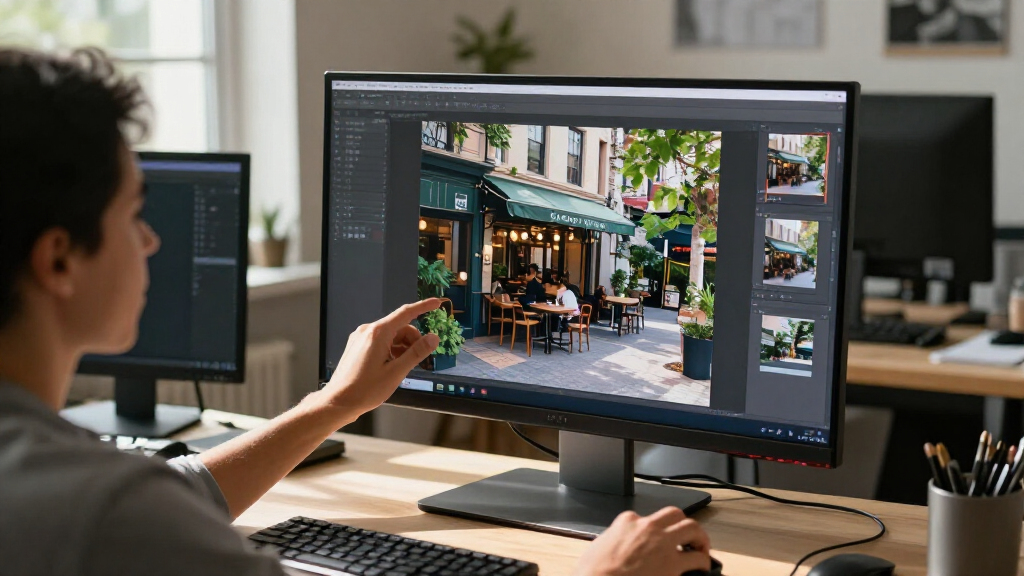
🔍 Read the full analysis: The Steps Diffusion Models Take To Generate Pictures on ThorstenMeyerAI.com

Get business pricing on office and shipping supplies
- Business-only prices and quantity discounts
- Tax-exempt purchasing
- Multiple users, one account, clear invoices
TL;DR
Diffusion models generate images by starting with random noise and repeatedly estimating and removing it, guided by a text prompt. The method is grounded in published research, but the supplied source is an explainer rather than a newly reported development; it also describes persistent limits in text, object placement and reproduction of training images.
Diffusion models create images by repeatedly removing estimated noise from a randomly generated starting point, with a text prompt steering each step, according to an explainer published November 23 by ThorstenMeyerAI.com. The account draws on published research and Stable Diffusion documentation to describe a widely used image-generation approach, rather than announcing a new model or research result.
The process has two stages. During training, a model receives real images that have been deliberately corrupted with increasing amounts of noise. Because the added noise is known, a neural network can be trained to estimate it from a noisy image and the step at which the image was corrupted. Repeating this task across many examples teaches the model how noise and image structure relate.
Generation runs the process in reverse. A model begins with random values and predicts a portion of the noise at each pass, then uses the less noisy result as the input for the next pass. The 2020 paper “Denoising Diffusion Probabilistic Models,” by Jonathan Ho, Ajay Jain and Pieter Abbeel, used 1,000 steps in its experiments. The researchers wrote that large-scale features appear before fine details. Later implementations can use fewer steps; the explainer says a widely used open-source pipeline runs 50 by default, though settings vary among tools.
Many systems do not perform this work directly on every pixel of a full-size image. The explainer says latent diffusion first compresses image information into a smaller representation. For Stable Diffusion v1, it reports that a 512-by-512 image becomes a representation with 48 times fewer numbers. A text encoder converts a prompt into numerical information, and guidance techniques use that information during denoising to encourage results that match the words.
Why Denoising Shapes Image Results
The step-by-step process helps explain both the capabilities and the recognizable weaknesses of image generators. A prompt does not direct a model to retrieve a specific photograph or draw each object in a fixed order. Instead, it influences repeated predictions as an image takes shape. That distinction matters when a result only partly follows instructions: the model is estimating plausible image structure, not necessarily following a precise scene plan.
According to the explainer, lettering, counting and precise object placement remain difficult. Those problems are consistent with a system that constructs an image through iterative statistical predictions rather than treating words as a checklist of objects and relationships. The source also says stronger prompt guidance can bring an output closer to the text, but may come at a cost to image quality. That is a trade-off, not a guarantee that more guidance will produce a better picture.
The account also addresses a public concern about training data. Researchers have extracted near-copies of some training images from models, the source reports. That is distinct from saying every generated image is copied, or that a model stores every training image in a recoverable form. The difference matters for discussions of model behavior, copyright and the evidence needed to evaluate a particular output.
Popular right now

iRobot Roomba Max 715 Robot Vacuum with AutoEmpty Dock

Sony WH-1000XM6 Wireless Noise-Canceling Headphones, Black

De'Longhi Classic Signature Espresso Machine with Adjustable Milk Frother
As an affiliate, we earn on qualifying purchases.
From Noise Experiments to Latent Models
The underlying idea predates current image-generation products. In a 2015 paper, Jascha Sohl-Dickstein and co-authors described gradually destroying structure in data and learning a reverse process to restore it. The practical breakthrough highlighted by the source came with Ho, Jain and Abbeel’s 2020 paper, which set out a training method based on adding noise to images and learning to predict it.
In that paper, the researchers used 1,000 forward noise steps. Under their schedule, the source calculates that the original image carries 81.2% of its weight after 200 steps, 28% after 500, and 0.6% after 1,000. These are values for that paper’s specified schedule, not universal settings for every diffusion model. The explainer then connects the general method to Stable Diffusion v1, whose documentation describes training a U-Net to predict noise added to a compressed latent representation. Its cited training material includes subsets of LAION-2B(en), a large web-image dataset.
The legal context is narrower than a broad ruling on AI training. The source says a UK court found in 2025 that Stable Diffusion itself is not an “infringing copy,” while other questions remain open. That finding should not be read as resolving every copyright dispute involving training data, generated images or other models.
“systematically and slowly destroy structure in a data distribution through an iterative forward diffusion process”
— Jascha Sohl-Dickstein and co-authors, 2015 research paper, as quoted by ThorstenMeyerAI.com
Limits, Settings and Legal Questions
The explainer does not compare current products or establish one standard number of generation steps. Its figures refer to particular research experiments or a cited open-source pipeline; other models, samplers and user settings can differ. Nor does it quantify how often systems produce incorrect text, misplace objects or reproduce training examples.
The source reports that researchers have extracted near-copies of training images, but it does not give details here about the studies, frequency or conditions of those results. The legal point is also limited: the described 2025 UK court finding concerns whether Stable Diffusion itself is an “infringing copy.” The source says other issues remain open, and does not specify how every dispute over training or output will be resolved.
What Research and Courts May Clarify
The explainer does not identify a scheduled launch, hearing or research milestone. The next developments to watch are research that tests how reliably image models follow instructions and how often they reproduce recognizable training material, alongside further legal decisions addressing questions the cited UK ruling did not settle.
For readers using image generators, the practical takeaway is to treat outputs as model-generated estimates, not dependable execution of every prompt detail. A generated picture may need review for text, object counts and spatial relationships. The exact result will depend on the model and its settings, details the source does not establish for any single product or image.
Key Questions
What does a diffusion model do to make a picture?
It begins with random noise and repeatedly estimates and removes some of it. A text prompt can guide those predictions toward a requested subject or scene.
How is a diffusion model trained?
Training adds known amounts of noise to images, then teaches a neural network to estimate the noise from the corrupted image and the step number. The method described by Ho, Jain and Abbeel appeared in a 2020 paper.
Why can image models struggle with words and object placement?
The source identifies lettering, counting and placing objects accurately as persistent difficulties. The generation process makes repeated predictions about image structure; it does not guarantee that every prompt instruction will be followed exactly.
Does a model always use 1,000 generation steps?
No. The 1,000-step figure refers to experiments in the 2020 paper. The explainer says one widely used open-source pipeline uses 50 steps by default, while settings vary across tools.
Did a UK court settle all copyright questions about Stable Diffusion?
No. The source says a UK court found in 2025 that Stable Diffusion itself is not an “infringing copy,” and also says other questions remain open. That finding does not resolve every dispute over training data or generated images.
Source: ThorstenMeyerAI.com