
📊 Full opportunity report: Can Local Governments Match Businesses With Empty Storefronts? on IdeaNavigator AI — validation score, market gap, and execution plan.

Get office and shipping supplies delivered free — and shop member deals
- Fast, free delivery on millions of items
- Access to Prime Big Deal Days deals on October 6–7
- Prime Video, Amazon Music and more included
TL;DR
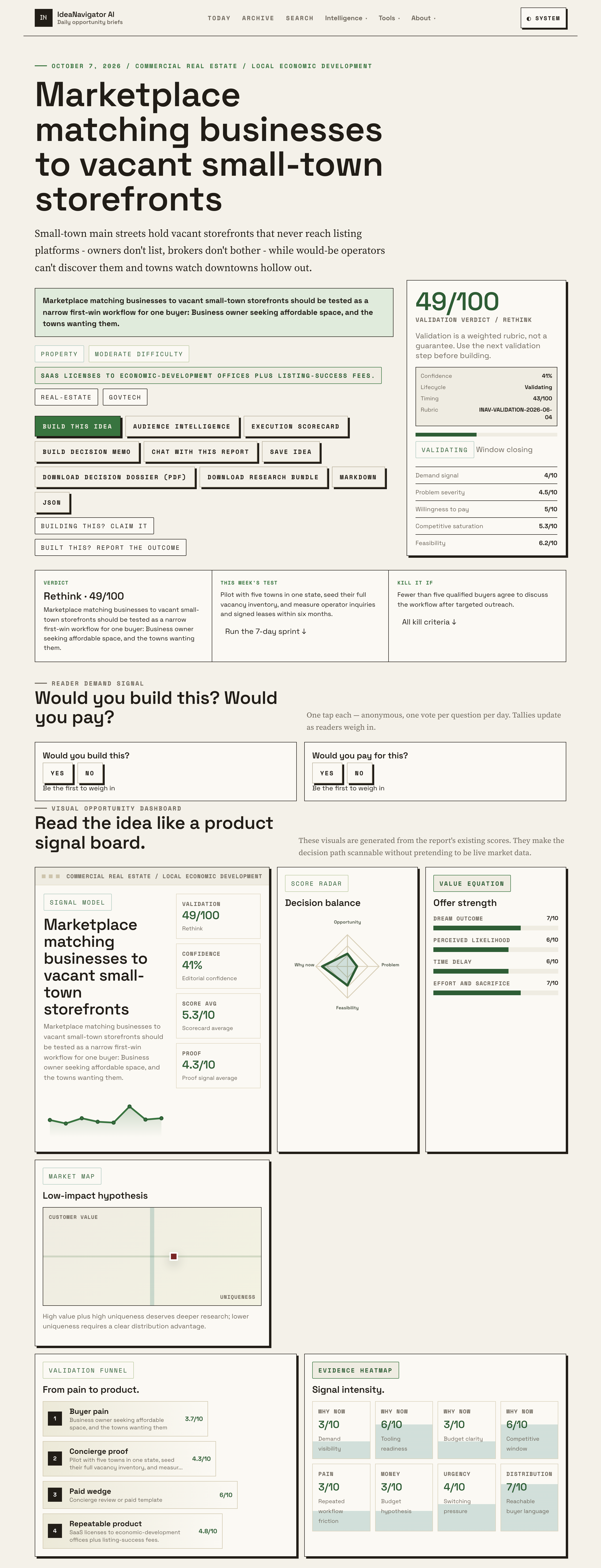
IdeaNavigator AI proposes testing a marketplace that lists vacant small-town storefronts and routes interested businesses to local economic-development offices. The concept has not been reported as launched or funded; a five-town pilot, with inquiries and signed leases tracked over six months, is proposed as a way to test demand.
IdeaNavigator AI has proposed a pilot marketplace to connect businesses seeking affordable space with vacant small-town storefronts, routing prospective matches to local economic-development offices. The concept is a proposal, not a reported operating service: its suggested test would cover five towns in one state and track operator inquiries and signed leases over six months.
The proposed listings would be created by towns and storefront owners and include photos, property size, rent and available incentive programs. Business operators would be able to browse locations using town profiles and foot-traffic data, according to the concept outlined by IdeaNavigator AI.
When an operator expresses interest, the proposed system would route the match to the relevant local development office, including information about grants available to support the opportunity. The outline does not specify how foot-traffic figures would be collected or verified, or whether property owners would be required to confirm listing details.
The suggested business model combines software subscriptions for economic-development offices with fees tied to successful listings. The proposal does not provide prices, projected revenue or evidence that towns or businesses have agreed to pay. It recommends first populating the pilot towns’ full vacancy inventories, then measuring inquiries and completed leases within six months.
A Test for Main Street Leasing
If the approach works, it could make storefronts easier to discover for operators who do not have access to local broker networks or conventional listing platforms. That could help towns connect available properties with potential tenants rather than relying on owners to market spaces individually. The proposal identifies this information gap as a barrier: some owners do not list properties, while brokers may not pursue smaller markets.
The practical test is not simply whether a marketplace can display vacant units. Its value would depend on whether listings are current, whether asking rents and incentives are clear, and whether interested operators can move from an online inquiry to a lease. Tracking signed leases as well as inquiries would help distinguish browsing activity from actual commercial occupancy.
For local governments, a shared listing and referral process might also help staff connect businesses to available grants. But the proposal offers no evidence yet that matching software alone can overcome other barriers, such as renovation costs, financing, property condition or a shortage of suitable operators. Those factors could determine whether increased visibility leads to occupied storefronts.
vacant storefront listing software
As an affiliate, we earn on qualifying purchases.
As an affiliate, we earn on qualifying purchases.
Why Vacant Spaces Go Unlisted
The proposal describes a mismatch between empty storefronts and prospective operators: owners may not post properties online, brokers may have little incentive to market them, and businesses may not know which spaces are available. In that account, local governments are positioned to gather inventory and connect parties because they work on downtown development and business recruitment.
IdeaNavigator AI also cites renewed interest in small towns associated with remote-work migration and says economic-development offices have access to grant funding for matching efforts. The outline provides no data quantifying that migration, the number of vacant storefronts, or the scale and eligibility of those grants. These points are part of the proposal’s rationale, not independently documented results in the material provided.
The recommended first step is deliberately limited: recruit five towns in one state, document their available storefronts, and assess performance over six months. A small, defined pilot could show whether towns can maintain useful listings and whether operators respond before a broader rollout is considered.
small town commercial property signs
As an affiliate, we earn on qualifying purchases.
As an affiliate, we earn on qualifying purchases.
Pilot Funding and Results Remain Open
No pilot towns, participating property owners, launch date or funding commitments are identified. It is also unclear whether any marketplace has been built, whether local offices have agreed to use one, or which grants would be attached to listings. No inquiries, leases or other outcomes are reported, so the concept’s effectiveness has not been established.
The proposal also leaves key operating details unresolved: who verifies rents and vacancy status, how often listings are updated, what foot-traffic measures mean, and how the platform handles privacy or disputes. Its suggested success-fee model is not defined, including what event would trigger a fee or who would pay it. Without those details, projected adoption and revenue cannot be assessed.
As an affiliate, we earn on qualifying purchases.
Six-Month Pilot Would Measure Leases
The next step proposed by IdeaNavigator AI is to select five towns in one state and seed the marketplace with their full inventory of vacant storefronts. The pilot would then track operator inquiries and signed leases over six months. No timetable for recruiting towns or starting that measurement period has been announced.
To judge the results, participating towns would need a consistent definition of an inquiry and a completed lease, plus a way to distinguish platform-generated matches from deals that would have happened through other channels. Reporting listing accuracy, time to response and lease outcomes could help show where the process succeeds or stalls. Until a pilot is launched and its results are made public, the marketplace remains an untested proposal.
Source: IdeaNavigator AI
As an affiliate, we earn on qualifying purchases.
Key Questions
Has the storefront marketplace launched?
No launch is reported. IdeaNavigator AI has outlined a proposed marketplace and a pilot approach, but no operating platform or launch date is identified.
How would the marketplace work?
Towns and property owners would list vacant storefronts with photos, size, rent and incentives. Operators could browse by town profile and foot-traffic data, with interested matches referred to local economic-development offices.
What would the pilot measure?
The proposal calls for a five-town pilot in one state and says it would track operator inquiries and signed leases over six months. No results are available because a pilot has not been reported as underway.
Who would pay for the service?
The suggested model combines software licenses sold to economic-development offices with fees tied to successful listings. Prices, fee terms and customer commitments have not been provided.
Would the marketplace guarantee that storefronts get tenants?
No. The proposal describes a way to improve discovery and referrals, not a guarantee of leases. Its effectiveness would depend on operator demand, accurate listings, property suitability and other factors.
Source: IdeaNavigator AI
Fall Picks
fall essentials
As an affiliate, we earn on qualifying purchases.