📊 Full opportunity report: Best Quiet CPU Coolers for Sustained AI/Compute Loads on ThorstenMeyerAI.com — validation score, market gap, and execution plan.
TL;DR
This article reviews the best quiet CPU coolers suited for sustained AI and compute workloads in 2026. It compares air and liquid cooling options, highlighting their performance, noise levels, and reliability for long-term use.
In 2026, the leading CPU coolers for sustained AI and compute workloads are identified as the Noctua NH-D15 G2 for top-tier air cooling and the Arctic Liquid Freezer III Pro 360 for liquid cooling, addressing the need for quiet, reliable performance during long, heavy workloads.
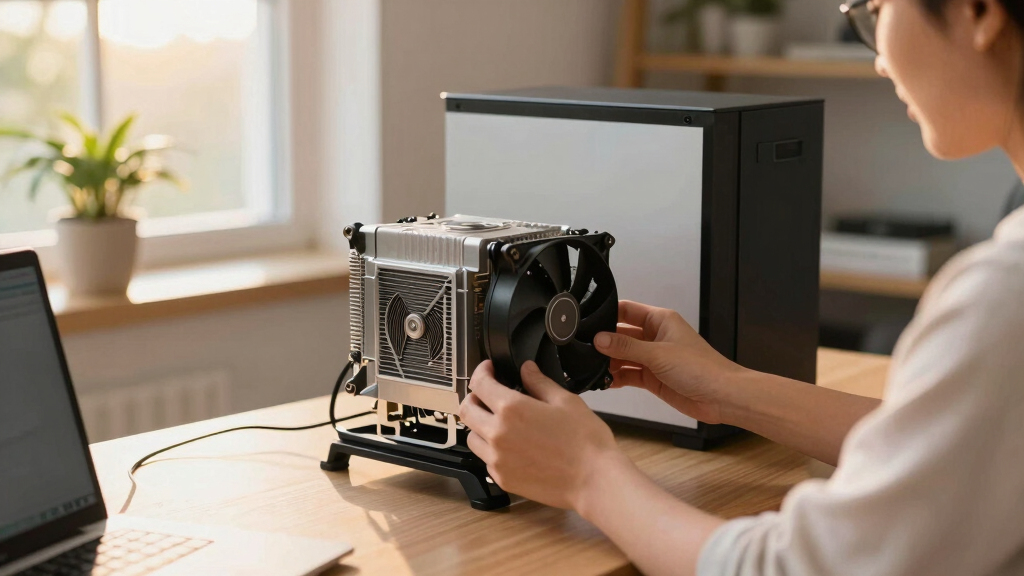
The Noctua NH-D15 G2 remains the benchmark for air cooling, offering exceptional thermal capacity and near-silent operation, making it ideal for always-on AI workstations. The Thermalright Peerless Assassin 120 SE provides high performance at a significantly lower cost, delivering 90-95% of flagship cooling efficiency for a fraction of the price. For silence-focused setups, the be quiet! Dark Rock Pro 5 excels, maintaining low noise levels under sustained loads. On the liquid cooling front, the Arctic Liquid Freezer III Pro 360 stands out as the most effective AIO for high-TDP workloads, providing steady temperatures and quiet operation over long periods. These choices reflect a shift in cooling priorities from peak performance to consistent, quiet operation suitable for continuous AI training and inference tasks.Best quiet CPU coolers
for sustained AI loads.
A cooler that’s fine for gaming bursts can run out of headroom on hour three of an inference job. What matters here isn’t peak capacity — it’s holding a steady temperature at a quiet fan speed, all day. Tap your priority in Part 3 to find your pick.
- Mainstream to high-end CPU, power-capped.
- You run it 24/7 — no pump to fail, ever.
- You want zero maintenance for years.
- Quiet matters more than the last few degrees.
- Top-tier CPU under sustained all-core load.
- A big air tower won’t physically fit (multi-GPU case).
- You want maximum sustained thermal headroom.
- You’ll accept a pump as one more moving part.
Impact of Cooler Choice on Long-Running AI Workstations
Choosing the right cooler affects system stability, noise levels, and maintenance over years of operation. Reliable, quiet cooling solutions reduce downtime and improve user comfort, especially in professional AI environments where sustained loads are common. The shift toward larger, slower fans and bigger heatsinks emphasizes the importance of thermal capacity at low noise levels, crucial for developers and data scientists working long hours without interruption.As an affiliate, we earn on qualifying purchases.
Evolution of Cooling Needs for AI Workloads
Traditional gaming PC coolers focus on managing peak temperatures during short bursts, but AI and compute workloads require sustained thermal management. As AI models grow larger and training durations extend, cooling solutions must handle continuous high loads without ramping fans loudly or risking thermal throttling. The market has responded with high-capacity air coolers and large-diameter fans, alongside high-performance AIOs, to meet these demands. Notably, reliability over years is a key consideration, with air coolers generally favored for their simplicity and longevity, while AIOs are preferred for their steady thermal performance at higher TDPs."For sustained AI workloads, thermal capacity at low noise levels is more critical than peak performance. Larger heatsinks and slower fans provide the best balance for long-term reliability."
— Thorsten Meyer, AI cooling expert
liquid cooling system for high TDP CPUs
As an affiliate, we earn on qualifying purchases.
As an affiliate, we earn on qualifying purchases.
Remaining Questions About Cooling Performance and Longevity
It is not yet clear how these coolers will perform over multiple years of continuous operation, especially in diverse environmental conditions. Long-term reliability data for the latest models are still emerging, and real-world use may reveal differences not evident in initial testing. Additionally, the impact of future CPU TDP increases on cooling capacity remains uncertain.silent air CPU cooler for long workloads
As an affiliate, we earn on qualifying purchases.
As an affiliate, we earn on qualifying purchases.
Next Steps for AI Workstation Cooling in 2026
Manufacturers are expected to release updated models with improved thermal capacity and quieter operation. Users should monitor long-term performance reports and consider integrating undervolting and power management techniques to optimize cooling efficiency. Further research and testing will clarify the longevity and reliability of these solutions in various operational environments.As an affiliate, we earn on qualifying purchases.
Key Questions
Are air coolers sufficient for high-end AI workloads?
Yes, high-quality air coolers like the Noctua NH-D15 G2 can handle sustained loads for most high-end CPUs, provided the workload remains within their thermal capacity. For the hottest CPUs under continuous heavy load, liquid cooling may offer more consistent temperature control.
How important is noise level for AI workstations?
Noise level is critical for long-term comfort and productivity, especially in office or shared environments. Coolers like the be quiet! Dark Rock Pro 5 are designed to operate near inaudibly under load, making them ideal for noise-sensitive setups.
What are the advantages of liquid cooling over air cooling for AI workloads?
Liquid coolers, especially high-capacity AIOs like the Arctic Liquid Freezer III Pro 360, provide more consistent thermal performance during prolonged, high-TDP workloads. They also tend to operate more quietly at high loads but introduce potential points of failure such as pumps and seals.
Can I upgrade my cooler later if my workload increases?
Yes, many coolers are compatible with a range of CPUs and cases, allowing upgrades. However, larger coolers require sufficient case space and clearance, so planning ahead is advisable.
Source: ThorstenMeyerAI.com