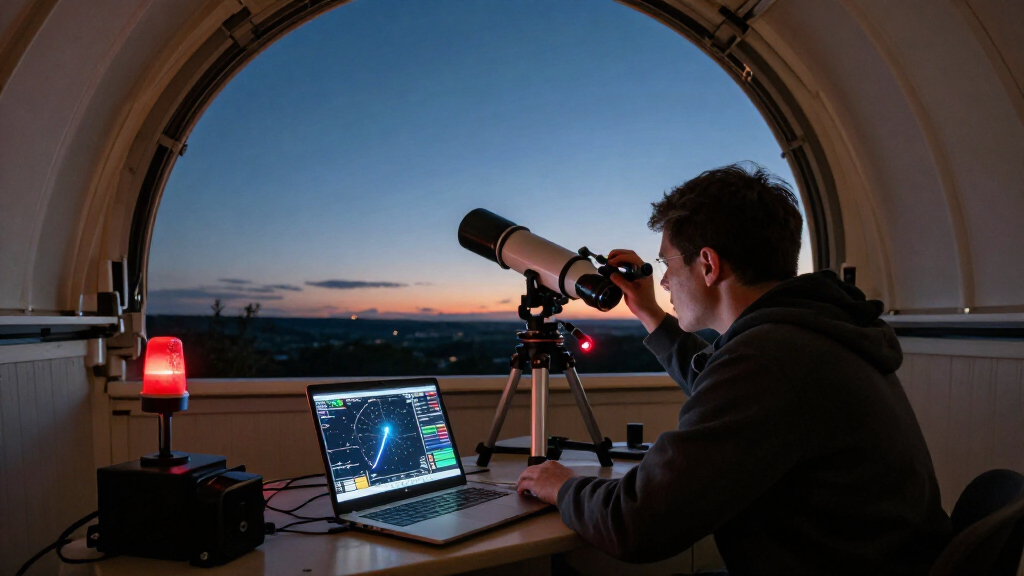

🔍 Read the full analysis: Held Light And AI: The Technique Behind “OORT — Comet Vigil For P/2043 K1 Vesper” on ThorstenMeyerAI.com

Get business pricing on office and shipping supplies
- Business-only prices and quantity discounts
- Tax-exempt purchasing
- Multiple users, one account, clear invoices
TL;DR
OORT — Comet Vigil for P/2043 K1 Vesper is an AI-built exhibition website about a fictional comet and an imagined observatory. Its signature feature accumulates seeded star trails during a visit, while other interactive graphics respond to scrolling and user input; the site identifies the comet and observatory as fictional.
OORT — Comet Vigil for P/2043 K1 Vesper, an AI-built web exhibition, makes time spent on a page part of its artwork: a seeded field of stars draws longer curved trails as visitors stay, as detailed in the original analysis. The piece centers on an imaginary observatory and fictional comet, using interactive graphics to stage a long wait rather than document a real astronomical object.
The site’s central technique, described as “held light”, is a canvas animation in which stars arc around a point below the visible frame. Their trails lengthen with elapsed time, and a repeatable seed keeps the sky consistent on the visitor’s device. The page saves elapsed time locally, allowing the same local sky to resume when someone returns. The work is presented as an artwork about duration, not as a live astronomical feed.
A second visual instrument ties scrolling to an inline SVG depiction of the comet’s changing position. The design specifies an ion tail directed away from the sun and a dust tail that curves along the imagined orbit; both respond to the same progress value as the displayed distance and year. A range control changes a defocus view and its associated brightness estimate. These are features of the fictional presentation, not reported measurements of a real comet.
Visitors can also hold a control briefly to open a simulated shutter. The site records a timestamp, but, according to its description, the interaction does not reveal a fabricated sighting: the comet remains unseen and in transit within the story. The accompanying design brief calls for animation to pause when a browser tab is hidden and for a still version for people using reduced-motion settings. The source describes these requirements but does not independently document performance testing.
Interactive art · AI-built exhibition
Held Light & AI:
The Technique Behind OORT
Inside “Comet Vigil for P/2043 K1 Vesper,” an imagined observatory turns time spent on a page into part of the artwork. Its comet and sky are fictional; its central experiment is how code makes waiting visible.
“Your visit is the exposure.”
Art-direction brief · FABLE/175How the Site Makes Waiting Visible
01 / The techniqueOORT makes remaining on a page an artistic action. A seeded canvas of stars draws longer curved trails as a visit continues. Elapsed time is saved locally, so a visitor can return to the same local sky. The visual record changes with duration instead of presenting one fixed image.
A consistent field
A repeatable seed keeps the star arrangement consistent on the visitor’s device, giving the animation a recognizable starting point.
Trails grow longer
Stars arc around a point below the visible frame. As time passes, their trails build a visual record of the vigil.
Local persistence
Elapsed time is stored locally, allowing the same sky to resume when someone returns. The experience is an artwork, not a live astronomy feed.
Scroll-linked orbital view
An inline SVG illustration moves with page progress. The described design points the ion tail away from the sun and curves the dust tail along the imagined orbit. Displayed progress, distance and year share that progress value. These are fictional presentation details, not verified measurements.
From Attention to Simulated Exposure
02 / Visitor interactionOther graphics respond to scrolling and input, extending the exhibition’s central idea: interaction can express attention without presenting fiction as observation.
“The page makes duration part of the artwork instead of treating it as time spent before the content.”
A range control adjusts a defocus view and its associated brightness estimate. The interface describes a fictional instrument, not a real comet measurement.
Inside the FABLE/175 Exhibition
03 / Art directionThe published account places OORT in room 170 of the 175-room FABLE/175 collection. It describes a live room, a design guide and a “Prompt” link in the exhibition footer that exposes the art-direction brief.
Deep dark backgrounds, cyan readings and ion tail, warm red-orange instructions, and pale dust-toned text.
The brief credits Claude Fable 5 and says the FABLE/175 pipeline executed the work.
Initial build and self-critique, external critique and fixes, then art-direction review; screenshots were requested at three widths.
Fictional Comet, Unverified Testing
04 / Read with contextP/2043 K1 Vesper is identified as fictional. The supplied account gives no basis for treating its orbital premise, dates, brightness or imagined observatory history as real astronomical data. It also describes quality goals without independently confirming that the live site meets them.
Accessibility and behavior goals
Pause animation when a browser tab is hidden; provide a still version for reduced-motion settings; support readable contrast and responsive layouts.
Testing results
The source does not supply independent performance results, browser compatibility findings, accessibility audits or records confirming each review and test.
Key Questions
Quick referenceIs P/2043 K1 Vesper a real comet?
No. The source identifies it as fictional and presents OORT as an imagined observatory’s vigil.
What does “held light” mean?
Seeded stars leave curved trails that grow with elapsed time. Local storage lets the same local sky resume when a visitor returns.
Does the shutter reveal a sighting?
No. It opens a simulated shutter and records a timestamp as a mark of attention. The comet remains unseen and in transit within the story.
How does scrolling affect the comet graphic?
Scrolling moves the inline SVG illustration. Its tails, displayed progress, distance and year are described as linked to the same progress value.
Is accessibility and performance verified?
The brief specifies goals such as reduced-motion handling and hidden-tab pauses, but the supplied material includes no independent test results.
Where can readers explore further?
Visit the live OORT room, consult its linked design guide and explore the wider FABLE/175 collection. No future release is specified.
How the Site Makes Waiting Visible
OORT treats a familiar web habit—remaining on a page—as an artistic action. Instead of presenting a finished image that is the same at every visit, it lets elapsed time change the visual record. The accumulated trails give duration a visible form, while local persistence makes returning part of the experience.
The distinction between a simulated observatory and a real one matters. The site borrows the language of astronomy, including orbital paths, readings and a shutter, but its stated subject is fictional. That framing lets the work explore patience, attention and digital interaction without implying that visitors are tracking or witnessing a verified comet. Its value for readers interested in creative technology lies in how code and interface behavior carry the concept, rather than merely decorating a conventional page.
As an affiliate, we earn on qualifying purchases.
Inside the FABLE/175 Exhibition
The source lists OORT as room 170 of 175 in the FABLE/175 collection and links it to a live site and a design guide. The published material says the exhibition’s footer includes a “Prompt” link exposing the art-direction brief that produced the room. That brief is attributed to Claude Fable 5 and says the work was executed by the FABLE/175 pipeline.
The brief describes a dark, observatory-inspired interface: deep black backgrounds, cyan for the ion tail and readings, warm red-orange for instructions, and pale dust-toned text. It calls for display typography with an engineered feel and monospaced coordinates and notes. It also specifies a three-pass process—initial build and self-critique, external critique and fixes, then art-direction review—and asks for screenshots at three screen widths. The source describes that process; it does not provide independent records of each review or test.
Beyond the browser piece, the brief proposes fictional observatory details such as amateur vigil logs, a long wait and historical provenance for the imagined comet. Those elements belong to the work’s invented setting. The supplied account does not identify any real observation or orbit record for P/2043 K1 Vesper.
““The page makes duration part of the artwork instead of treating it as time spent before the content.””
— The OORT exhibition description
As an affiliate, we earn on qualifying purchases.
Fictional Comet, Unverified Testing
P/2043 K1 Vesper is identified as fictional, so the source provides no basis for treating its stated orbital premise, dates or brightness as real astronomical data. The design brief includes invented observatory history and technical-sounding details, but does not establish them as factual observations.
The supplied material also does not give independent performance results, browser compatibility findings or accessibility audit data. It specifies reduced-motion behavior, tab-hidden animation pauses, readable contrast and responsive layouts as goals. Whether the live site meets every one of those targets across devices is not independently confirmed in the source.
As an affiliate, we earn on qualifying purchases.
Explore the Live Room and Guide
Readers can visit the live OORT room to see how its sky changes during a session, then consult the linked design guide for the described visual and technical approach. The exhibition also points to the wider FABLE/175 collection. No future release, real-world observation or additional development milestone is specified in the supplied material.
As an affiliate, we earn on qualifying purchases.
Key Questions
Is P/2043 K1 Vesper a real comet?
No. The source describes P/2043 K1 Vesper as fictional and presents OORT as an imagined observatory’s vigil.
What does “held light” mean in OORT?
It refers to the canvas effect in which seeded stars leave curved trails that grow with elapsed time. The site stores elapsed time locally so the same local sky can resume when a visitor returns.
Does the shutter interaction show a comet sighting?
No. It opens a simulated shutter and records a timestamp as a mark of attention. The exhibition description says the comet remains unseen in the experience.
How does scrolling affect the comet graphic?
Scrolling moves the comet through an inline SVG. The displayed account says the ion tail points away from the sun while the dust tail follows a curved path, with the illustration’s progress, distance and year linked together.
Is the site’s accessibility and performance verified?
The art-direction brief specifies reduced-motion handling, pausing animation in hidden tabs, responsive screen widths and other quality targets. The supplied material does not include independent test results confirming that every target was met.
Source: ThorstenMeyerAI.com
Halloween Picks
halloween
As an affiliate, we earn on qualifying purchases.