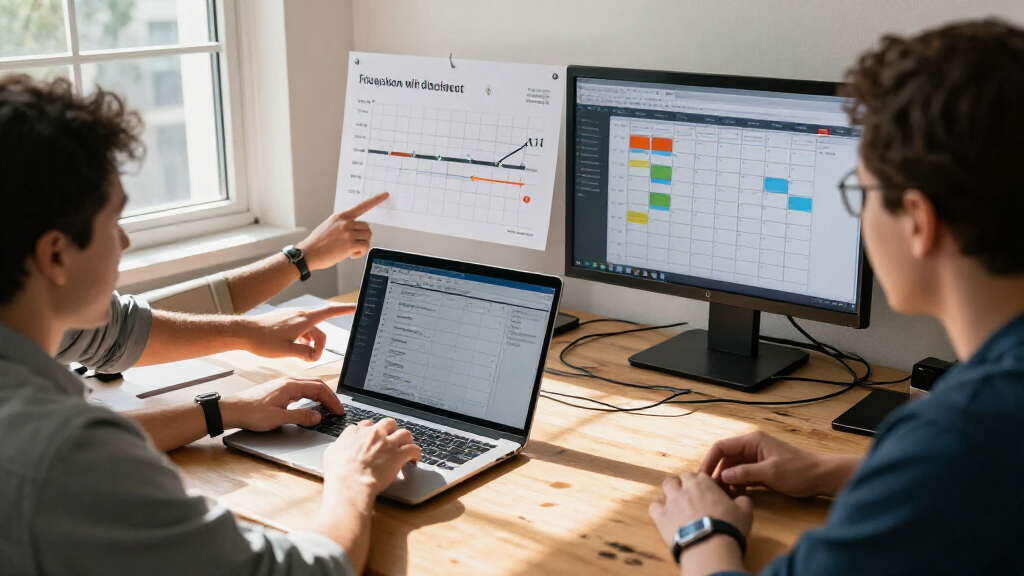

🔍 Read the full analysis: How Much Work Can AI Handle Today? Measure The Time Horizon on ThorstenMeyerAI.com

Get business pricing on office and shipping supplies
- Business-only prices and quantity discounts
- Tax-exempt purchasing
- Multiple users, one account, clear invoices
TL;DR
METR’s public benchmark lists an 80% task time horizon of 185.9 minutes for an early Claude Mythos Preview released in April 2026. That means the model is predicted to complete four out of five tasks of comparable human difficulty in METR’s test setting—not that it can reliably work independently for three hours. The benchmark has limits, and its public results have not been actively updated since September 2026.
A November 18 guide from ThorstenMeyerAI.com points to METR’s task time horizon as a way to estimate how much work AI agents can handle: the best model listed in METR’s public results completed tasks with a human-expert duration of about three hours at an 80% success rate. The figure is a benchmark estimate, not a measure of dependable three-hour work sessions, and the public results have not been actively updated since September 2026.
METR, an independent research nonprofit, defines the time horizon as the human expert completion time of tasks at which an AI agent is predicted to succeed at a chosen reliability level. The guide uses the 80% threshold: a model is expected to succeed on four of five comparable attempts. METR’s measure concerns task difficulty, not how long the AI spends doing the work; agents can complete tasks they solve faster than a person would.
According to METR’s Time Horizon 1.1 results file, the record at that threshold is 185.9 minutes for an early Claude Mythos Preview dated April 7, 2026. The guide compares that with 66 minutes for GPT-5.2 in December 2025, 29.98 minutes for o3 in April 2025 and 0.89 minutes for GPT-4 in March 2023. METR’s reported confidence interval for the Mythos result is broad, from 97.3 to 398.5 minutes.
The guide says METR measures tasks completed by skilled professionals, then has AI systems attempt each task in six independent runs. The current benchmark suite, Time Horizon 1.1, contains 228 tasks across fields including software engineering, machine learning and cybersecurity. METR’s process also treats cheating identified in run transcripts as failure. These design choices make the figure a specific benchmark result, rather than a direct measure of all workplace activity.
Reliability changes the estimate substantially. The guide reports a 50% time horizon of 1,044.8 minutes—about 17.4 hours—for the same Mythos Preview, compared with 185.9 minutes at 80%. It also relays METR’s warning that measurements above 16 hours are unreliable with its current task suite. The higher figure should not be read as a robust estimate of dependable work.
Using the Horizon to Plan Work
The time horizon offers managers a way to frame questions about AI-assisted work: how long would a skilled person need for a task, and how often does the model finish work of that difficulty? The measure can inform decisions about which assignments to test with AI and how much review may be needed.
The guide recommends dividing work into short, clearly specified pieces with an acceptance check, beginning with tasks that can be tested, and measuring performance on a team’s own work. A benchmark success rate of 80% means failures occur in roughly one attempt out of five under the measured conditions. For tasks where mistakes are costly or difficult to detect, teams may require more review or a higher reliability threshold.
The guide also cites evidence that benchmark performance may not translate cleanly to everyday work. It says messier tasks in one METR comparison cut the horizon by almost a factor of three. It also reports that in a 2025 METR trial, experienced developers were 19% slower with AI while believing they were 20% faster. The guide presents these findings as reasons to test workflows and track verification time rather than assume benchmark performance will reduce labor.
Popular right now

Dyson V9 Motorbar Cordless Vacuum

Apple AirPods Pro 3 Wireless Earbuds with Active Noise Cancellation
Philips 5500 Series Fully Automatic Espresso Machine with LatteGo Milk System
As an affiliate, we earn on qualifying purchases.
How METR Measures Task Length
METR’s approach starts by timing skilled people on defined tasks. The professionals in the task suite have an average of about five years of relevant experience, according to the guide. METR then runs an AI agent on each task multiple times and plots success against the human time required. As tasks get longer, success rates generally fall; the fitted curve’s crossing at 80% gives the 80% horizon. The 50% horizon marks a different reliability level.
The public results show a steep rise over several years, but the guide’s description of a doubling every three to seven months is an extrapolation from past measurements, not a guarantee of future progress. It says its own estimates put an eight-hour workday at 80% reliability somewhere between September 2026 and November 2027, depending on which years of data are used. The article also says no measurements after April 2026 had been made public in the cited material.
METR’s public record has a further limitation: its page says it is no longer actively updated and was last updated September 8, 2026. The guide cites a separate February-to-March 2026 Frontier Risk Report, in which METR estimated the labs’ internal frontier at 80% to be at least three hours but under four hours. That estimate is not the same as a newer public benchmark result.
“The task duration (measured by human expert completion time) at which an AI agent is predicted to succeed with a given level of reliability.”
— METR, as quoted in the ThorstenMeyerAI.com guide
Limits of the Three-Hour Estimate
The result does not establish how the model would perform across all work settings. METR’s tasks are described as clean and well specified, while the guide says less tidy tasks reduced the measured horizon in one comparison. It does not provide enough detail here to assess how broadly that reduction applies across different jobs, tools or organizations.
The wide confidence interval also means the 185.9-minute estimate carries substantial uncertainty. The 80% figure is a fitted estimate across task attempts, not a guarantee for any particular assignment, and a model can still fail on one in five attempts at that threshold. METR’s public benchmark page is no longer actively updated, so the source material does not establish whether newer public evaluations would change the record.
The guide mentions a separate study in which reviewers caught only 31% of errors that required knowledge of the task’s rules to identify. The supplied material does not give enough methodological detail to apply that figure to every review process. It does, however, indicate that checking AI output can require relevant expertise and time.
Testing AI on Team Backlogs
The practical next step in the guide is for teams to run their own evaluations, using representative tickets and a clear definition of success. It recommends starting with testable work measured in hours, recording both completion and review time, and choosing a model based on the task rather than relying on one general benchmark score.
The guide also recommends repeating those measurements each quarter as models and workflows change. METR’s publicly cited benchmark, however, was not actively updated after September 8, 2026, according to the guide. No newer public measurement or update schedule is provided in the source material, so the next confirmed benchmark milestone remains unclear.
Key Questions
What does an AI time horizon of about three hours mean?
It means METR estimates the model can complete tasks that take a skilled human about three hours with an 80% success rate in the benchmark setting. It does not mean the AI works for three hours or will succeed on every task of that length.
Which model holds the cited public 80% result?
The guide identifies an early Claude Mythos Preview, dated April 7, 2026 in METR’s results file, with an 80% time horizon of 185.9 minutes. Its reported confidence interval ranges from 97.3 to 398.5 minutes.
Why is the 50% horizon much longer?
A 50% threshold allows success on about half of attempts, while 80% requires success on four out of five. The guide reports a 50% horizon of about 17.4 hours for the same model, but says METR considers measurements above 16 hours unreliable with its current task suite.
Can companies use the benchmark to predict productivity gains?
Not on its own. The benchmark measures performance on a defined task suite, and the guide says messier work can produce a shorter horizon. Teams would need to test representative tasks and count the time spent checking and correcting outputs before estimating productivity effects.
Source: ThorstenMeyerAI.com