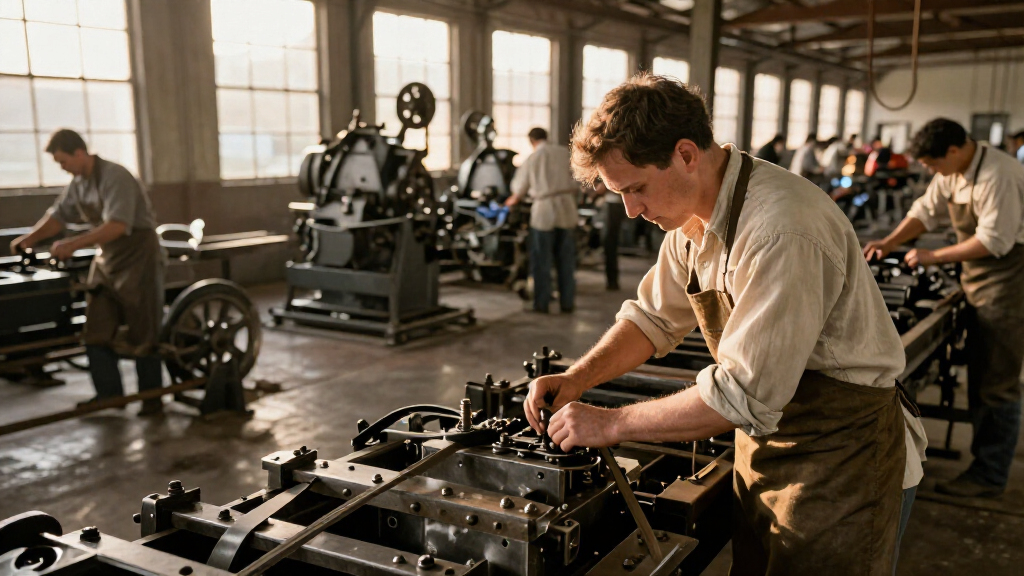

🔍 Read the full analysis: The Five-Dollar Day: Work And Pay On The Assembly Line on ThorstenMeyerAI.com

Get business pricing on office and shipping supplies
- Business-only prices and quantity discounts
- Tax-exempt purchasing
- Multiple users, one account, clear invoices
TL;DR
On January 5, 1914, Ford Motor Co. cut the workday from nine hours to eight and raised eligible workers’ minimum daily pay from $2.34 to $5 under a conditional profit-sharing plan. The change followed assembly-line production gains and severe turnover; figures cited in the source report turnover falling to 54% in 1914. The account challenges the popular claim that Ford acted mainly so workers could afford his cars.
Ford Motor Co. raised its minimum daily pay to $5 and shortened the workday from nine hours to eight on January 5, 1914, as it struggled to keep workers on its fast-changing assembly lines. A November 6 account by Thorsten Meyer says the policy was conditional profit sharing and argues that the company’s immediate problem was high employee turnover, not a shortage of customers for its cars.
The production shift was already underway at Ford’s Highland Park plant in Detroit. According to figures Henry Ford published in his 1922 book, assembling a Model T chassis required 12 hours and 28 minutes of labor when the vehicle remained stationary. By early 1914, the moving line had cut that figure to 1 hour and 33 minutes. Those figures represent labor time per chassis, not the total time a car spent in the factory.
The faster process relied on dividing assembly into smaller tasks and moving parts past workers. Ford’s account says the company first tested a line in 1913 on a flywheel magneto, splitting its assembly into 29 operations. The source describes the figures as coming from Ford’s own account, so they reflect the company’s published version of its production history.
Ford’s workforce figures point to the pressure behind the pay change. Research cited by Meyer reports that the company hired 50,448 people in 1913 to maintain an average workforce of 13,623, a turnover rate reported as 370%. The account says turnover fell to 54% in 1914. It also reports that one worker in ten was absent on an average day before the policy, although the supplied material does not give a separate source citation for that absenteeism figure.
Why Ford Changed the Pay Deal
The episode matters because it connects a famous wage policy to the practical costs of industrial production. Ford’s line increased output per worker, but the account describes a workforce in which people routinely left or missed work. Recruiting and training replacements would have disrupted a system built around a tightly sequenced set of tasks. The five-dollar day was therefore not just a higher wage: it was also an effort to make the labor force more stable.
The source attributes Ford’s later description of the policy as “one of the finest cost-cutting moves we ever made” to his own account. That framing underscores the business rationale, but it does not establish that cost savings were the only motive. The source says workers received the higher minimum through a conditional profit-sharing arrangement; it does not provide the full eligibility rules or show how many employees qualified.
The account also challenges the familiar explanation that Ford raised pay so employees could buy Model Ts. It notes that Ford employed about 14,000 people and produced roughly 250,000 cars a year around 1914, and says the company’s immediate difficulty was retaining workers. That evidence supports a turnover-focused explanation, though production and workforce figures alone cannot establish every consideration behind the decision.
Popular right now

Hisense 43-Inch E6SR Series Hi-QLED 4K UHD Smart Roku TV (2026 Model)

Bose QuietComfort Ultra Earbuds (2nd Gen) – Wireless Noise‑Cancelling Earbuds with Mic, Immersive Audio, USB‑C Charging, Up to 6 Hours Batte

Ninja Flip Toaster Oven and Air Fryer, 8-in-1, Stainless Steel, SP151
As an affiliate, we earn on qualifying purchases.
From Stationary Cars to Moving Lines
Before the moving line, workers assembled a car around a stationary chassis, bringing parts to it. Ford’s experiment changed the sequence: the chassis moved while workers performed assigned tasks. The source says the first rough chassis line was pulled along a 250-foot path with a rope and windlass. That trial reduced the reported labor time to 5 hours and 50 minutes, before further changes brought it down to 1 hour and 33 minutes by early 1914.
Ford described the method in terms of reducing workers’ movements and the need for individual judgment. Tasks were divided so that, for example, one person inserted a bolt and another fitted or tightened the nut. The account also traces the moving line’s inspiration, in Ford’s telling, to overhead rails used in Chicago meatpacking plants. These details come primarily from My Life and Work, which Ford wrote with journalist Samuel Crowther and published in 1922.
The change took place during a period of expanding factory employment. Meyer’s account says U.S. factory jobs rose by about a third between 1910 and 1920. That broader figure provides context for the growth of industrial work, but it does not by itself show how the Ford line affected employment across the entire economy.
““the reduction of the necessity for thought on the part of the worker and the reduction of his movements to a minimum.””
— Henry Ford, as quoted in My Life and Work
Limits of Ford’s Historical Record
The production-time figures and descriptions of the early line rely heavily on Ford’s 1922 account. The source identifies that material as the company’s side of the story; it does not provide comparable testimony from workers describing the pace, conditions, or effects on their daily lives. The turnover figures are attributed to a 1987 study by economists Daniel Raff and Lawrence Summers, drawing on earlier research and company surveys, but the supplied material does not reproduce those underlying records.
The exact conditions attached to the five-dollar payment are also not laid out in the source material. It describes the plan as profit sharing with strict conditions, but does not specify all requirements, how eligibility was determined, or how many workers received the full amount. The account’s figures on output and employment do not establish that the pay increase was motivated by a single factor, and the claim that it was designed to help workers buy cars is presented as a legend, not as a directly tested statement of Ford’s intentions.
How the Account Frames the Legacy
The November 6, 2026, source is a historical episode, not a report of a new policy change or an ongoing investigation. Its next step is to continue the series’ examination of how production systems shape work. The account closes by connecting the assembly line’s continued use to the growing presence of robots, but it gives no current figures or specific forecast about automation.
For readers assessing the historical claim, the key evidence to watch is the distinction between Ford’s own published account and later research based on company and labor records. Further detail on the profit-sharing rules, workers’ experiences, and how the turnover rate was calculated would help clarify what the five-dollar day changed—and for whom.
Key Questions
What was Ford’s five-dollar day?
On January 5, 1914, Ford cut the workday from nine hours to eight and raised the minimum daily pay to $5 through a conditional profit-sharing plan, according to the source account.
Why did Ford raise wages?
The account says the company was struggling with high worker turnover. It reports that Ford hired 50,448 people in 1913 to maintain an average workforce of 13,623. The source presents retention as the immediate business problem, while not proving it was the only motive.
How much faster did the assembly line make chassis production?
Ford’s 1922 account gives labor time of 12 hours and 28 minutes per chassis before the moving line and 1 hour and 33 minutes by early 1914. These are reported labor-time figures, not necessarily the full elapsed time to manufacture a car.
Did Ford raise wages so workers could buy Model Ts?
The source disputes that familiar explanation and says Ford’s pressing problem was keeping workers, rather than finding customers. It does not establish that worker purchasing power played no role in the decision.
Did every Ford worker receive five dollars a day?
The source says the pay came through profit sharing with strict conditions, but it does not provide the complete eligibility rules or the number of workers who received the full amount.
Source: ThorstenMeyerAI.com