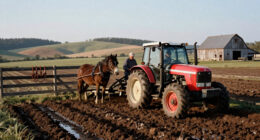

🔍 Read the full analysis: Why The History Of Farming Matters In The Age Of AI on ThorstenMeyerAI.com

Get business pricing on office and shipping supplies
- Business-only prices and quantity discounts
- Tax-exempt purchasing
- Multiple users, one account, clear invoices
TL;DR
A November 3, 2026, article from ThorstenMeyerAI.com uses farming’s long shift from human labor to mechanized, higher-output production to frame questions about AI and work. It reports that agriculture now employs about 928 million people worldwide, while the author’s forecast that automation could affect up to 90% of a sector is explicitly a thesis, not an established finding.
ThorstenMeyerAI.com published an analysis on November 3 tracing how farming’s labor share fell as tools, fertilizer and crop breeding increased output, using that history to examine what AI could mean for work. The piece reports that about 928 million people still work in agriculture worldwide, and cautions through its historical account that a decline in workers can take generations rather than happen in a single technological leap.
The article’s central U.S. comparison comes from economic historian Stanley Lebergott’s estimates, published by the Census Bureau: in 1800, about 1.4 million of a 1.9 million labor force worked in agriculture, or 73.7%. The figures for years before 1840 are estimates, not census counts, and the series includes enslaved people. The article says the 1800 estimate includes about 530,000 enslaved people, whose labor was coerced.
Farming’s change came through a sequence of developments, not one invention. The article points to John Deere’s steel plough in 1837, industrial ammonia production following Fritz Haber’s 1908 patent, and short-straw wheat developed and adopted during the Green Revolution. It cites Indian statistics showing wheat production rose from 12.3 million tonnes in 1964-65 to 26.4 million tonnes in 1971-72; the article attributes the seed development’s spread to plant breeders around Norman Borlaug and the Nobel Foundation.
The article also distinguishes the share of workers in farming from the number of farm workers. In the United States, the number continued to rise until about 1910, when it reached a reported 11.8 million, even as farming’s share of the workforce declined. For the present day, it cites an International Labour Organization estimate of 928 million agricultural workers in 2025, around one in four workers globally. The article gives national comparisons of about 43% in India, 1.5% in the United States and 1% in Germany.
What Farm Labor History Shows
The comparison matters because AI debates often focus on whether a new technology eliminates jobs, while the farming history also asks how quickly work changes and where workers go. The article’s account shows that agricultural employment fell over a long period as output rose. That history does not establish that AI will produce the same outcome: farming involved specific technologies, economic conditions and labor movements that may not map neatly onto office or service work.
For readers, the key distinction is between automating tasks and removing an entire sector’s need for people. Even in agriculture, where machinery and scientific advances transformed production, hundreds of millions of people still work in the sector. The timeline also challenges the assumption that fewer workers automatically mean less food. The article reports that global cereal harvests grew 4.2-fold from 1961 while population grew 2.7-fold, though those figures describe historical changes and do not by themselves identify every cause.
The author’s projection that automation could affect as much as 90% of a sector within a decade or a few decades is presented as a thesis, not a measured forecast. Readers should treat it differently from the historical employment and production figures cited in the article.
Popular right now

Apple AirPods Pro 3 Wireless Earbuds with Active Noise Cancellation

TCL 65-Inch QM6K QLED Mini-LED 4K HDR Smart Google TV, 144Hz

iRobot Roomba 105 Robot Vacuum with LiDAR Navigation
As an affiliate, we earn on qualifying purchases.
From Muscle to Mechanized Farming
In the article’s account, the starting point is an economy in which most food production depended on human and animal labor. It cites estimates that agriculture and related primary-sector work accounted for about 85% of workers in Japan in 1872, and that 83.5% of employed people in China worked in the primary sector in 1952. These figures come from historical reconstructions or national series, and definitions differ between countries.
The article describes several changes that raised farm productivity. A steel plough could move through sticky Midwestern soil more effectively than earlier designs, while later reapers, threshers and tractors mechanized more tasks. Haber’s ammonia synthesis made industrial nitrogen fertilizer possible; the article dates his patent to October 13, 1908 and says the first ammonia factory opened in 1913. Improved crop varieties, fertilizer and irrigation later worked together to lift yields. The source presents these as successive changes, not a single cause of falling farm employment.
Its broader AI framing follows that history: technological change can raise production while reducing the proportion of workers needed for a particular activity. But the article does not claim that agricultural experience provides a precise timetable or outcome for AI. Farming’s transformation took roughly two centuries in the United States, and the shift remains incomplete globally.
“The share fell long before the headcount.”
— Thorsten Meyer, article author
Limits of the AI Comparison
The article does not establish how many jobs AI will eliminate, which occupations will change, or on what timetable. Its suggested possibility of automation affecting up to 90% of a sector is the author’s thesis, and the source material provides no forecast method or supporting labor-market estimate for that figure.
Historical numbers also have limits. Early U.S. labor estimates are not census counts, country comparisons use different dates and definitions, and agricultural statistics do not isolate the effect of one invention from changes in markets, policy, infrastructure or population. The source cites output growth alongside labor changes but does not claim that technology alone explains them. It is also unclear from the article how quickly workers displaced from particular farm tasks moved into other occupations, or how that experience compares with workers whose tasks may be affected by AI.
The Series Turns to Machinery
The article is identified as Episode 2 of the “Work After Work” series, which examines how the economy is built. It says Episode 3 will cover mechanical reapers, threshers and tractors, extending the account of how agricultural tasks were mechanized.
For the AI comparison, the next useful evidence will be data on actual adoption, changes in tasks and employment, and whether productivity gains create or shift work elsewhere. The farming history offers a historical comparison, but the article does not provide a timetable for AI’s effects or confirm that the same pattern will repeat.
Key Questions
What development does the article report?
ThorstenMeyerAI.com published an analysis on November 3, 2026, using the history of agricultural labor and productivity to discuss how readers might think about AI and work.
How many people worked in U.S. agriculture around 1800?
The article cites Stanley Lebergott’s estimate that 1.4 million of a 1.9 million U.S. labor force worked in agriculture in 1800, or 73.7%. The figure is an estimate, not a census count, and includes enslaved people.
How many people work in agriculture worldwide today?
The article cites an ILO estimate of 928 million agricultural workers in 2025, around one in four workers worldwide. It also reports that the share differs substantially by country.
Does the article predict that AI will eliminate 90% of jobs?
No. The author describes automation affecting up to 90% of a sector as a thesis, not a fact. The article does not provide a verified forecast that AI will eliminate 90% of jobs or specify which sector the projection would apply to.
Does farming’s history prove AI will have the same effects?
No. The article uses agriculture as a historical comparison, but says its transformation unfolded over a long period. It does not establish that AI will follow the same timeline or produce the same employment and output results.
Source: ThorstenMeyerAI.com