📊 Full opportunity report: Parental Consent Management In The Youth-Services Software Landscape on IdeaNavigator AI — validation score, market gap, and execution plan.

Get business pricing on office and shipping supplies
- Business-only prices and quantity discounts
- Tax-exempt purchasing
- Multiple users, one account, clear invoices
TL;DR
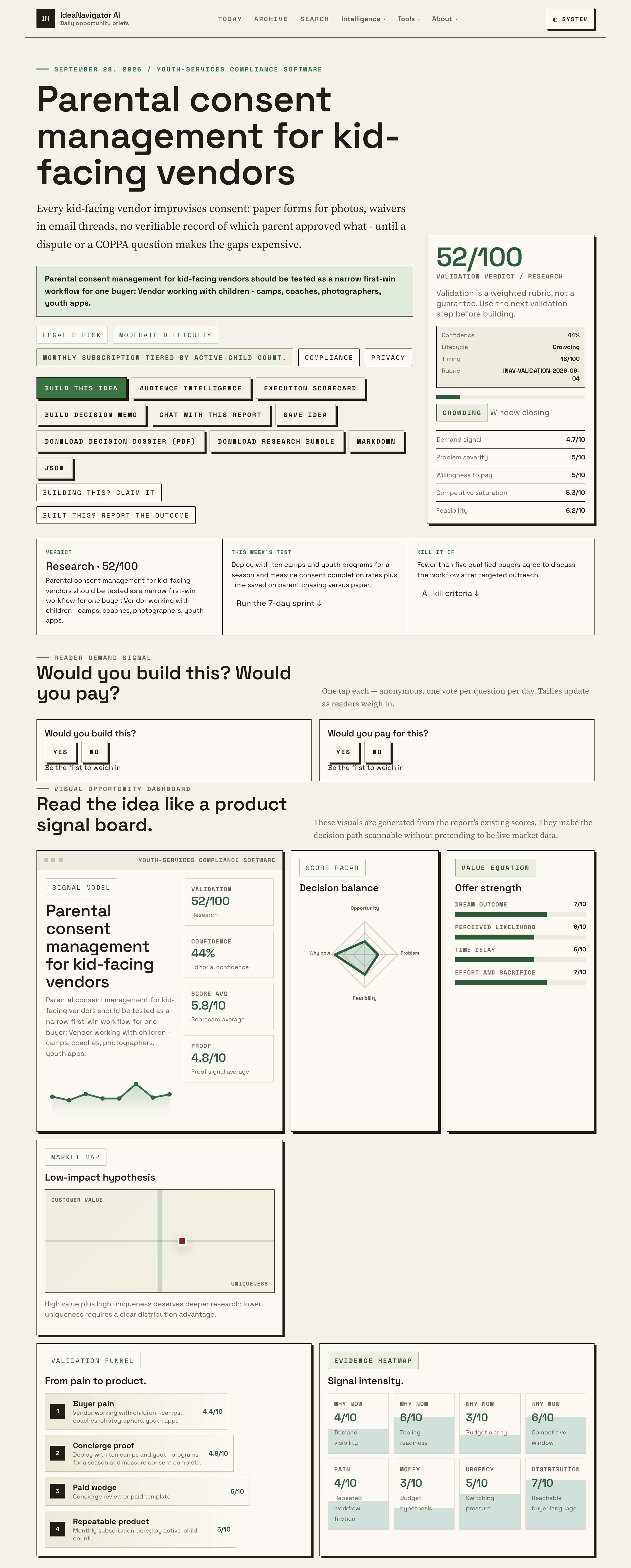
A proposal for youth-service vendors outlines mobile parental consent forms, per-child records, expiry tracking and audit exports. The concept has not been shown to be a launched product or tested service; its proposed validation is a season-long trial with ten camps and youth programs.
The suggested system would let vendors send branded forms for parents to complete on their phones. The proposed consent categories include photo use, data collection, medical information and liability. Records would be organized by child, with expiry tracking and an option to export an audit record. Identity checks would vary according to the perceived risk of the consent request.
The business model described is a monthly subscription priced by the number of active children. The proposal identifies youth-service businesses as the initial buyer, including camps, coaches, photographers and youth-focused apps. It does not provide pricing, product specifications, customer commitments or evidence of revenue.
To assess whether the workflow solves a practical problem, the proposal recommends deploying it with ten camps and youth programs for a season. Suggested measures are consent completion rates and the staff time spent following up with parents compared with paper-based processes. No pilot has been reported, and no results are available.
Consent Records for Youth Programs
For organizations working with children, consent can cover distinct activities and types of information. Keeping a verifiable record of who approved what could help staff answer questions from parents and document permissions when records are requested. The proposal frames those recordkeeping gaps as a business problem, especially when approvals are spread across forms and email threads.
The idea also speaks to operational workload: a shared digital process might reduce repeated reminders and make expired permissions easier to identify. That benefit remains a hypothesis to test. Completion rates, staff time and the reliability of the records would need to be measured in actual programs before vendors could judge whether a subscription is worthwhile.
Paper Forms and Rising Scrutiny
The proposal says many child-facing vendors improvise their consent processes, using paper forms for photographs and email threads for waivers, without a clear record linking a parent’s approval to a specific child and use. It identifies disputes over photos or data, and questions about compliance, as situations in which those gaps may become costly.
It also cites changing children’s privacy requirements, including updates to the U.S. Children’s Online Privacy Protection Act and state laws, alongside parents’ concerns about how photos and data are used. The proposal does not identify particular laws, enforcement actions or dates, so it does not establish how each rule applies to camps, coaches or other vendors. Applicability depends on the service and the information collected.
Product and Pilot Evidence Missing
No product launch, customer adoption or pilot findings are described. The proposal does not say how identity checks would work, how parent-child relationships would be verified, what security protections would apply, or how records would be retained and corrected. It also leaves open how the system would handle separated guardians, shared custody, changing permissions or urgent medical updates.
The proposed ten-program season trial has no reported start date or participating organizations. Without completion and time-saving results, it is unclear whether vendors would pay for the service, which consent categories are most urgent, or whether the suggested active-child pricing would suit programs with seasonal enrollment.
A Ten-Program Season Trial
The next step proposed is a season-long deployment with ten camps and youth programs. The trial would track how often parents complete consent requests and compare staff follow-up time with the paper process. Those measures could help determine whether the workflow saves time and produces usable records.
Further product decisions would depend on the trial: vendors would need to assess verification levels, expiry rules, audit exports, privacy safeguards and subscription pricing. No timetable, vendor commitments or launch plan has been announced in the available proposal.
Source: IdeaNavigator AI
Key Questions
Has a parental-consent platform launched?
The proposal describes a potential workflow. It does not report a launched product or customer adoption.
Who is the proposed service for?
It targets vendors serving children, including camps, coaches, photographers and youth apps.
What would the proposed workflow include?
Mobile forms for photo, data, medical and liability consent, plus per-child records, expiry tracking and audit exports.
How would the idea be tested?
The proposal recommends a season-long trial with ten camps and youth programs, measuring consent completion and staff time spent following up with parents.
Source: IdeaNavigator AI
Fall Picks
fall essentials
As an affiliate, we earn on qualifying purchases.