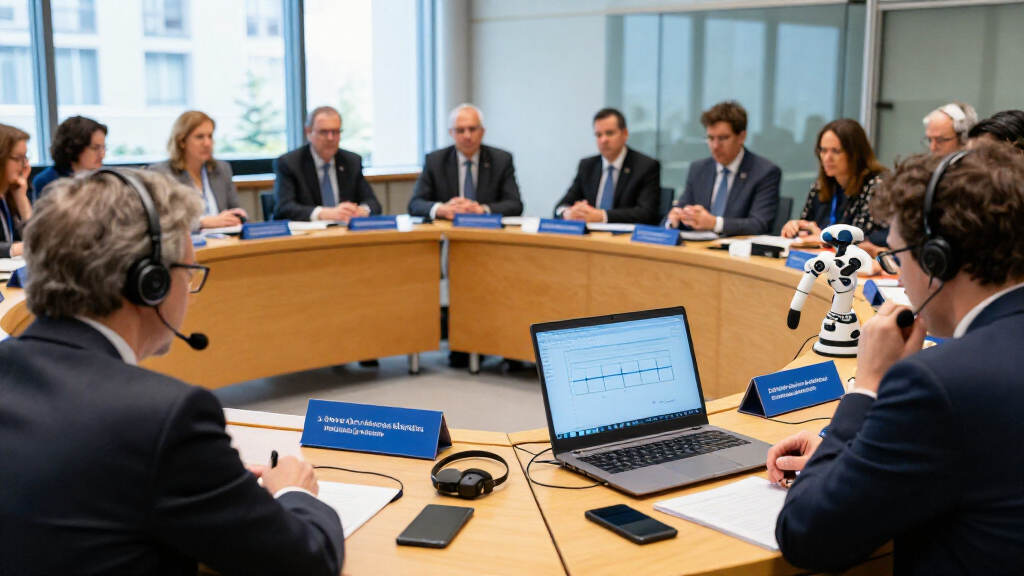
🔍 Read the full analysis: The Road To 2028: Where UN Killer Robot Talks Stand on ThorstenMeyerAI.com

Get business pricing on office and shipping supplies
- Business-only prices and quantity discounts
- Tax-exempt purchasing
- Multiple users, one account, clear invoices
TL;DR
At the UN’s November 2026 review conference, states tasked an expert group with developing an instrument on lethal autonomous weapons and reporting in 2028. They did not commit to a treaty: the instrument’s legal form remains open, and the group has 10 meeting days each year in 2027.
States at the Seventh Review Conference of the UN Convention on Certain Conventional Weapons agreed on November 21 to have an expert group develop an instrument on lethal autonomous weapon systems and report in 2028. The decision does not commit governments to a binding treaty: it leaves the instrument’s legal form open, after states failed to adopt the stronger proposed mandate to negotiate a new protocol.
The final document directs the Convention’s open-ended Group of Governmental Experts to “elaborate, by consensus, an instrument” addressing international humanitarian law and other possible measures for lethal autonomous weapons. It says the work should consider how existing law applies, as well as the need to codify and progressively develop that law. The group must recommend the instrument’s “legal nature and specific form,” including whether states should adopt it as a binding protocol.
The group is scheduled to meet for 10 days in Geneva each year. Its 2027 sessions are set for March 1–5 and August 30–September 3. A chair’s update is due to a meeting of states parties on November 10–12, 2027; the group’s report is to go to the 2028 meeting. The conference also endorsed 20 paragraphs of elements agreed by the expert group in September 2026.
Those elements cover a working definition, the full application of international humanitarian law, human judgment and control, legal reviews, testing, and steps to address bias in data and AI models. They provide agreed subject matter for continued discussions, but the source documents do not describe them as a new binding set of rules. The conference’s decision is recorded in CCW/CONF.VII/CRP.1/Rev.3, published by the UN disarmament office as the final document.
UN talks on autonomous weapons
From “negotiate” to “elaborate”: the road to 2028
What the weapons convention (CCW) has done so far, and what it agreed in Geneva. Blue: decided. Ochre with “?”: still open.
Dates from the official documents
- First meeting of expertsSet up by the CCW states; talks have run ever since
- 20 paragraphs of elements agreedDefinition, law applies fully, human judgement, accountability
- The mandate for the next two years negotiate a new Protocolelaborate an instrument “without prejudging its nature”
- 10 days of meetings in Geneva1 to 5 March and 30 August to 3 September
- Report and recommendationBinding protocol or not: the group must recommend, by consensus
Sources: CCW final document CCW/CONF.VII/CRP.1/Rev.3 (adopted, Nov 20, 2026), pages 6 to 7; GGE report CCW/GGE.1/2026/3, Sep 14, 2026; working paper CCW/CONF.VII/WP.7, Nov 18, 2026; mandate proposal listed under Main Committee II.
Graphic: Powered by Thorsten Meyer AI
What the 2028 Mandate Could Change
The outcome keeps a multilateral process moving on weapons that can select and attack targets without a person deciding each strike. But the difference between developing an instrument and negotiating a treaty is consequential: the decision establishes no new legal obligation for states and guarantees no binding agreement by 2028.
The September elements could still matter before then. They identify subjects governments have agreed to discuss, including human control, weapons reviews and testing. For defense contractors and companies supplying dual-use AI, those topics may feature in procurement, export and compliance discussions even while no new treaty is in force. That is a likely practical effect, not a requirement created by the conference decision itself.
The timing is also part of the debate. Critics argue that a process extending to 2028 is too slow as autonomous systems develop and are used in armed conflict. Supporters of continued work can point to an agreed mandate and common negotiating material after more than a decade of discussions. The decision advances the process, while leaving its central outcome unsettled.
Popular right now

Vitamix VX1 Professional-Grade Blender, 64 oz, Black

eufy C28 Robot Vacuum and Mop with 15,000 Pa Suction

Roborock Qrevo 2 Pro Robot Vacuum and Mop with 20,000 Pa Suction
As an affiliate, we earn on qualifying purchases.
From Protocol Proposal to Open Mandate
The talks take place under the Convention on Certain Conventional Weapons, where decisions are made by consensus. The expert group on lethal autonomous weapons has been working within the Convention since 2013, according to a paper by seven states. Consensus means a state can prevent agreement on a proposed decision, a feature that shaped the final wording.
Austria, Belgium, Brazil, Ireland, Mexico, New Zealand and Panama called for an “explicit, clear, time-bound negotiating mandate” for a new protocol. Their proposal envisaged a one-year negotiation with 25 meeting days. Another proposal on the conference agenda called for a mandate to negotiate a new protocol and set 15 meeting days a year.
The adopted decision instead uses “elaborate” and says the instrument’s nature is not prejudged, while allocating 10 meeting days a year. Reuters reported that Russia opposed the outcome sought by proponents of binding rules; Reuters and Politico also reported Russian procedural objections that led to formal meetings being cancelled. Reuters and Al Jazeera reported that the United States, Russia and Israel opposed the push for binding rules. These accounts describe countries’ positions; the final document itself names no state as responsible for the narrower mandate.
“Some countries had rejected the word “negotiate.””
— Swiss Ambassador Julien Thöni, conference president, as reported by Al Jazeera
Treaty Form and State Positions Remain Open
The final text does not decide whether the instrument will be a binding protocol. That recommendation is assigned to the expert group, and governments will still need to consider its report. The decision also does not set out specific new obligations on weapon design, deployment or use.
Reporting by Reuters, Politico and Al Jazeera describes opposition to binding rules and procedural disputes, but the adopted UN document does not identify the countries behind the final compromise or explain each delegation’s position. The precise influence of individual states on the wording therefore remains based on reporting and attributed accounts, not the text itself.
Nor does the decision establish how much agreement the group can reach before 2028, or whether states will ultimately accept its recommendation. The endorsed elements provide a basis for further work, but the source material does not establish that they have been implemented as national policy or procurement standards.
Geneva Sessions Lead to 2028 Review
The expert group is due to meet in Geneva on March 1–5, 2027, and again on August 30–September 3, 2027. Its chair is scheduled to update states parties at their November 10–12 meeting. The group is then expected to submit its report to the 2028 meeting, including a recommendation on the instrument’s legal nature and form.
The next test is whether governments can use those sessions to narrow differences over the text and its legal status. Until the report and states parties’ response, a binding protocol remains one possible outcome—not an agreed destination.
Key Questions
Did the UN agree to ban killer robots?
No. States agreed to develop an instrument on lethal autonomous weapons, but the decision does not itself ban them or create new binding rules.
Will the 2028 instrument be legally binding?
That remains undecided. The expert group must recommend the instrument’s legal form, including whether states should adopt a binding protocol.
What happens in 2027?
The expert group is scheduled to meet for 10 days in total across sessions in March and August–September. Its chair is also due to update states parties in November.
Which countries blocked the stronger proposal?
The final conference document does not name any country. News reports attributed opposition to binding rules to the United States, Russia and Israel, and reported Russian procedural objections; those are reported accounts, not a country-by-country explanation in the adopted text.
Source: ThorstenMeyerAI.com