
TL;DR
The most effective way to quiet a noisy rig isn’t foam or soundproofing alone — it’s moving it out of your space. When you place it in a closet, proper ventilation, door sealing, and targeted acoustic treatment turn a small space into a surprisingly good vocal booth or quiet workstation.
Ever wondered if you can turn a closet into a quiet, professional sound space? The truth is, a closet booth can work wonders — if you treat it right. It’s not just about slapping foam on the walls; it’s about understanding the real problems: noise leaking out, reflections bouncing around, and heat building up.
This guide will show you how to optimize your closet setup, whether you’re recording vocals, voice-over, or just trying to keep your noisy rig from disturbing the house. For more insights, check out this guide on acoustic treatment in small spaces. We’ll cover placement, acoustic treatment, and the secret weapon: moving your rig out of the room altogether.
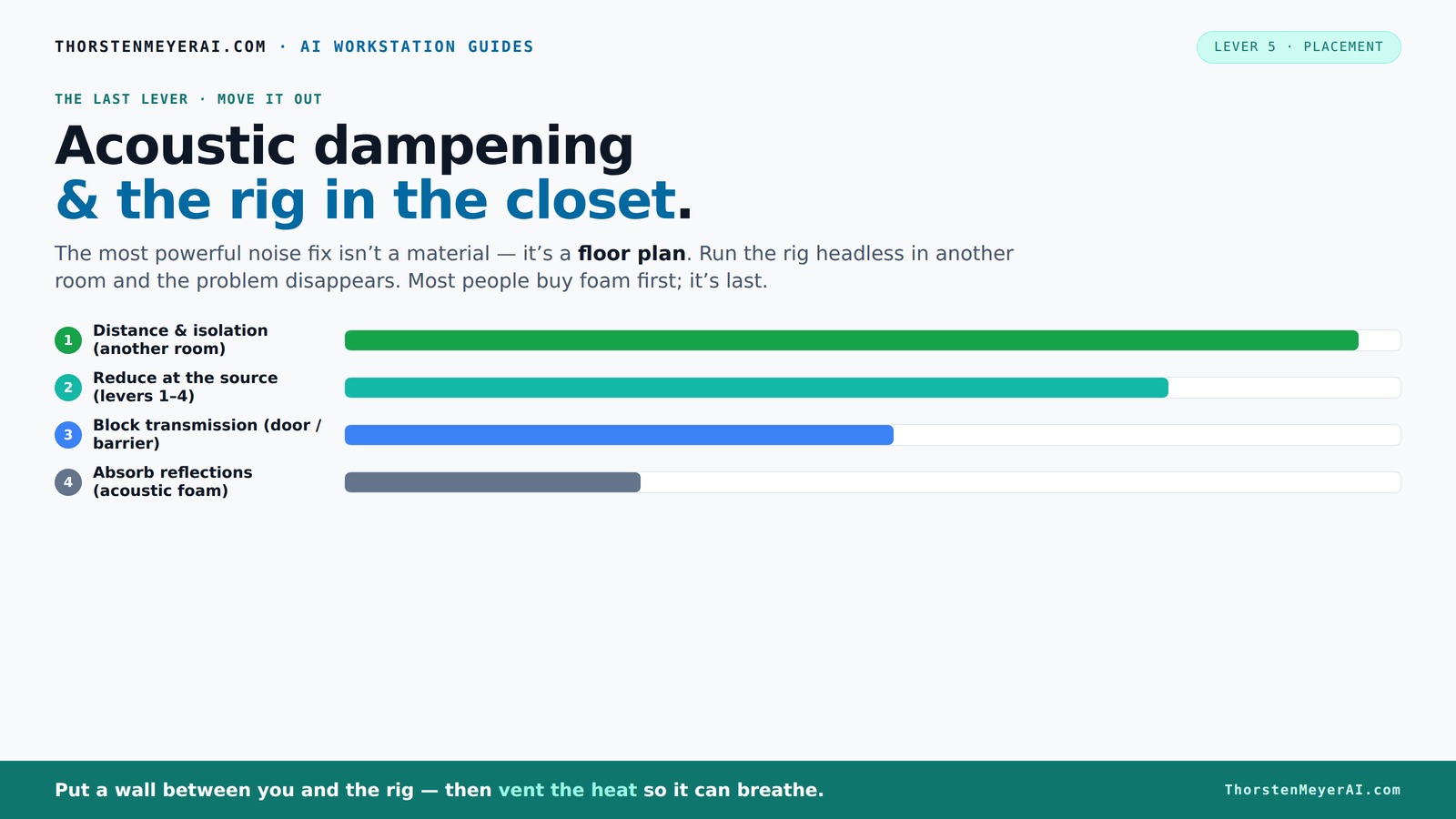
Acoustic dampening
& the rig in the closet.
The most powerful noise fix isn’t a material — it’s a floor plan. A rig you can’t hear because it’s in another room beats any amount of foam. Tap the approaches in Part 1 to see what actually works.
(another room)
(levers 1–4)
(door / barrier)
(acoustic foam)
Contain the noise, not the heat
Key Takeaways
- Moving your rig into another room or closet is the most effective way to silence it, especially for high-power work.
- Proper ventilation is non-negotiable; a sealed closet traps heat, risking overheating and throttling.
- Target first reflection points with foam or blankets to reduce echo and boomy sound in small spaces.
- Seal gaps around doors and vents to prevent sound leaks, using weatherstripping and acoustic seals.
- Layer treatment materials—foam, blankets, rugs—for a natural, controlled sound without making your space sound dead.

Ultimate Portable Vocal Booth for Home Recording, Reduces Echo & Reverb
- Original Portable Vocal Booth: Snap Studio created the category
- Reduces Echo and Reverb: Absorbs reflections for clear vocals
- All-in-One Recording Kit: Includes LED lights, mounts, mic adapter, and bag
As an affiliate, we earn on qualifying purchases.
As an affiliate, we earn on qualifying purchases.
Why Moving Your Rig Is the Best Noise Solution
When it comes to quieting your setup, distance is king. A rig placed in another room — a closet, basement, or spare space — can be silent to you while still doing its job. The advantage? You don’t need endless foam or expensive soundproof doors. Instead, you just run a network cable or Wi-Fi, and the noise stays behind closed doors.
Imagine working on a high-powered AI workstation. It can hum and roar all it wants in a closet, while your workspace remains peaceful. All you need is a reliable connection and proper ventilation. It’s like having your cake and eating it — power without noise.
Real-world tip: I set up a remote inference rig in my basement, and I connect to it over the network. My desk stays silent, and the rig in the closet handles the heavy lifting without a peep.
Why does this matter? Because reducing noise at the source often involves complicated and costly soundproofing. Moving the rig away from your primary workspace simplifies this drastically. It also allows your main area to be less cluttered with soundproofing materials, making it more versatile for different uses. The tradeoff? You need reliable network access and proper ventilation to maintain performance and prevent overheating.

Focusound 52 Pack Acoustic Foam Panels 1" x 12" x 12" Sound Proof Foam Panles Soundproofing Noise Cancelling Wedge Panels for Home Office Recoding Studio with 300PCS Double-Side Adhesive
- Soundproofing Design: Triangular grooves for noise absorption
- Includes Adhesive Tape: 300pcs double-sided adhesive for easy installation
- Easy Shape Recovery: Soak in water to restore shape
As an affiliate, we earn on qualifying purchases.
As an affiliate, we earn on qualifying purchases.
The 'Rig in the Closet' Setup — The One Big Catch
Placing your PC or GPU in a closet reduces noise dramatically, but it’s not a magic fix. The main challenge? Heat. A sealed closet traps hot air, and a 600W GPU running continuously will heat up the space fast. If you ignore this, your rig will throttle, fans will scream, and the noise problem reappears.
Understanding this tradeoff is crucial: silence often comes at the cost of increased heat. You can learn more about managing acoustic environments and heat in small spaces at this resource. Overheating can cause your hardware to throttle its performance to prevent damage, which defeats the purpose of having a powerful rig in the first place. Excess heat also risks damaging components over time. To counter this, you must implement effective ventilation strategies, like passive vents or exhaust fans, which introduce a balancing act: how to cool effectively without introducing noise or leaks that compromise your soundproofing.
For example, I used a small exhaust fan with a thermostat in my closet. It keeps the temperature stable, so my rig can run at full power without overheating or excessive noise. This approach requires careful placement of vents and choosing quiet fans, but it’s essential to maintain both performance and silence. Remember, neglecting heat management can turn your quiet setup into a noisy, overheating mess, so plan your ventilation carefully and weigh the tradeoffs between cooling and soundproofing.

OXRQ Door Draft Stopper, Door Sweep for Bottom of Door, Weather Stripping Door Seal Gap Filler Bottom Blocker Soundproofing Cold Air Insulation Save Energy Install Quickly Easily (Black, 39‘’)
- Material: Premium flexible silicone for durability
- Temperature Resistance: Heat and cold resistant material
- Energy Saving: Reduces heating and cooling costs
As an affiliate, we earn on qualifying purchases.
As an affiliate, we earn on qualifying purchases.
How to Make Your Closet a Quiet, Cool Space
Transforming a closet into a mini studio or rig room involves a mix of strategic placement and thoughtful treatment. Here’s a quick step-by-step:
- Seal gaps and the door: Use weatherstripping or acoustic seals to block sound leaks at the door. This prevents noise from escaping and external noise from entering, which is critical in small spaces where sound can easily bounce around.
- Layer your treatment: Combine acoustic foam, blankets, and rugs to absorb reflections and reduce echo. The layered approach is important because different materials target different frequencies and reflection points, creating a more balanced sound environment.
- Control reflections: Place foam panels at the first reflection points — behind the mic, side walls, and ceiling — to tame bounce-back. Proper placement ensures that sound waves are absorbed before they can bounce and create echo, which can muddy recordings and make your space sound unnatural.
- Address the floor: Lay down a thick rug or carpet to minimize reflections and standing waves. This step is often overlooked but can significantly improve clarity—especially in a small room where sound bounces off hard surfaces.
- Ventilate properly: Install a quiet exhaust fan or passive vents to keep airflow and heat in check. Proper ventilation isn’t just about cooling; it also prevents the buildup of stale air and humidity, which can affect both your gear and your comfort. For detailed strategies, see this guide on ventilation and acoustic treatment.
By understanding the why behind each step, you can tailor your setup to balance sound absorption and heat management. Learn more about effective acoustic treatment at this resource. For more detailed strategies, check out this guide on acoustic treatment in small spaces.
Remember, every modification impacts your space’s acoustics and temperature. The goal is to find the right balance: enough treatment to tame reflections without making the room sound dead, and sufficient ventilation to keep your gear cool and operational.

Portable Vocal Booth – Soundproof Portable Recording Booth for Echo-Free Vocals, Home Recording Booth with Travel Bag for Voiceovers, Podcasts & Music (Black)
- Superior Sound Isolation: Absorbs up to 90% of noise
- Spacious and Stable Design: Fits creators up to 6.4 ft tall
- Quick Setup: Unfolds in 60 seconds anywhere
As an affiliate, we earn on qualifying purchases.
As an affiliate, we earn on qualifying purchases.
What Really Works for Soundproofing a Tiny Closet
Acoustic dampening and soundproofing serve different but complementary purposes. In a closet, your priority is to reduce internal reflections and prevent sound from leaking out, but not necessarily to block every decibel. Soundproofing involves creating physical barriers—adding mass, sealing gaps, and constructing barriers—that prevent sound from passing through walls or doors. This often requires substantial modifications or specialized materials, which can be costly and complex.
Understanding this distinction helps set realistic expectations. Acoustic treatment like foam or blankets primarily absorbs sound waves inside the space, reducing echo and improving clarity. Conversely, soundproofing aims to prevent sound from escaping or entering, which is crucial if noise pollution outside the room is an issue. Overdoing soundproofing in a small closet can lead to a room that sounds dead or unnatural, while insufficient treatment leaves reflections and leaks.
Here’s a simple comparison: For more tips on soundproofing and acoustic treatment, visit this guide.
| Acoustic Treatment | Soundproofing |
|---|---|
| Absorbs reflections inside the space | Blocks sound from leaving or entering |
| Foam panels, blankets, rugs | Sealing gaps, adding mass, solid barriers |
| Improves clarity and reduces echo | Prevents sound leakage, increases privacy |
In a small closet, focus on sealing gaps around the door with weatherstripping, lining the interior with foam or blankets, and hanging a heavy curtain or blanket across the door opening. These steps significantly improve sound isolation without the need for extensive construction. Remember, the goal is a balanced approach: reduce reflections for clarity and seal leaks to prevent external noise from intruding. Proper ventilation remains essential to prevent heat buildup, which can compromise both your equipment and comfort.
Placement Hacks: Where to Put the Mic & How to Avoid Echo
Placement is everything when treating a closet for vocals or voice work. Start by deciding where your microphone will sit — usually, this is at the center of the room or closet space, away from walls. This reduces the chance of capturing unwanted reflections and echo that can make recordings sound muddy or boxy.
Use the rule of first reflection points: the wall behind the mic and sidewalls. Place foam panels at these points to absorb bounce-back sound, which is essential in small, reflective environments. Proper placement at these points ensures that the direct sound reaches the mic with minimal added reflections, preserving clarity and naturalness.
For example, if your mic is on a desk, put a foam panel behind it at ear height, plus on the side wall. A small stand or boom arm helps position the mic at the right angle, keeping it away from reflective surfaces that can cause comb filtering or echo.
Also, consider the height of your mic and your head position while speaking. Moving a few inches can dramatically change the sound by reducing proximity effects or reflections, resulting in cleaner, more natural vocals.
How Much Acoustic Treatment Is Enough? The Real Deal
In a tiny closet, covering 20-30% of the walls with 2-inch thick foam panels often provides a good balance between absorption and natural sound. Thicker panels (4-inch) are more effective at controlling low frequencies but can make the room sound overly dead if overused. The key is to target the most problematic reflection points—first reflection points, ceiling, and around the mic—while leaving some natural room sound for a balanced tone.
Layering different materials—foam panels, blankets, and rugs—helps absorb a broad spectrum of frequencies and reduces echo without completely deadening the space. This layered approach creates a more natural, professional sound that still retains some liveliness, which is often desirable for vocals and podcasts.
Over-treatment can lead to a space that sounds unnatural or overly muffled, so it’s important to listen critically and adjust accordingly. Balance the amount of treatment with the room’s size and your specific acoustic needs. For example, adding a ceiling cloud or hanging blankets can significantly reduce flutter echoes without overwhelming the space.
In practice, start with targeted placement of foam at reflection points, then add blankets or rugs as needed. Regularly listen and adjust to find that sweet spot where your sound is clear, natural, and free of unwanted reflections.
Common Questions About Closet Rigs & Acoustic Treatment
- Where should I place the microphone? Keep it at the first reflection point, about 6-8 inches from the wall behind it, and away from reflective surfaces. Proper placement minimizes unwanted reflections and ensures a clearer, more natural sound.
- Do I need bass traps? In a tiny closet, bass buildup is less of an issue, but if you notice boominess or low-frequency muddiness, adding bass traps in the corners or using thicker panels for low frequencies can help. They absorb problematic resonances that standard foam panels might miss, improving overall sound balance.
- Foam or blankets — which is better? Both work, but blankets are easier and cheaper to layer around the door and on walls for quick results. Foam is more durable and provides more consistent absorption but can be more expensive. Combining both can give you the best of both worlds, especially in a small space.
- How do I stop sound from leaking out? Seal gaps with weatherstripping, use a heavy curtain, and treat the door with acoustic sealant or a blanket. These steps help contain your sound inside the space, preventing external noise from seeping in and your noise from escaping.
- Will this setup work for vocals or podcasts? Absolutely. Proper placement, layered treatment, and sealing create a natural, clear sound, ideal for voice work. The key is to tailor your setup to your specific space and needs, listening critically and adjusting as you go.
Frequently Asked Questions
Can I really turn a closet into a professional-sounding booth?
Absolutely. With proper placement, layered treatment, and ventilation, a small closet can produce clean, natural recordings suitable for vocals, podcasts, or voice work. It’s all about smart setup and sealing leaks.How do I prevent my closet from sounding boxy or boomy?
Focus on treating first reflection points with foam or blankets, add a rug to reduce floor reflections, and seal gaps around the door. Layering materials prevents sound from bouncing around excessively. These steps help balance clarity and avoid unnatural deadness.Is foam enough for acoustic treatment in a tiny closet?
Foam panels help reduce echo and reflections, but they shouldn’t be the sole solution. Combining foam with blankets, rugs, and door sealing creates a more natural and effective acoustic environment. Over-reliance on foam alone can make the space sound sterile.How important is ventilation in a closet rig?
Vital. Without proper airflow, heat builds up quickly, risking overheating and throttling. Use quiet exhaust fans or passive vents to keep your gear cool and noise levels down, ensuring both performance and safety.Can a closet rig handle high-Power AI work?
Yes, provided you manage heat with ventilation and keep noise minimal through strategic placement. Proper cooling and noise control allow demanding workloads to run quietly, making your closet a cost-effective solution for high-performance computing.Conclusion
Your closet can become a surprisingly good studio, but only if you treat it like a small, reflective space that needs both sound absorption and proper airflow. Moving your noisy rig out of the room, combined with strategic placement and sealing, makes a huge difference. It’s about working smarter, not just adding more foam.
Remember: quiet, cool, and well-placed beats noisy and overheated every time. With these tips, your closet can be the secret weapon for clean, professional audio — without the headache of constant noise and heat.