📊 Full opportunity report: Why Pesticide-Residue Monitoring Is Essential For Food Safety Assurance on IdeaNavigator AI — validation score, market gap, and execution plan.
TL;DR
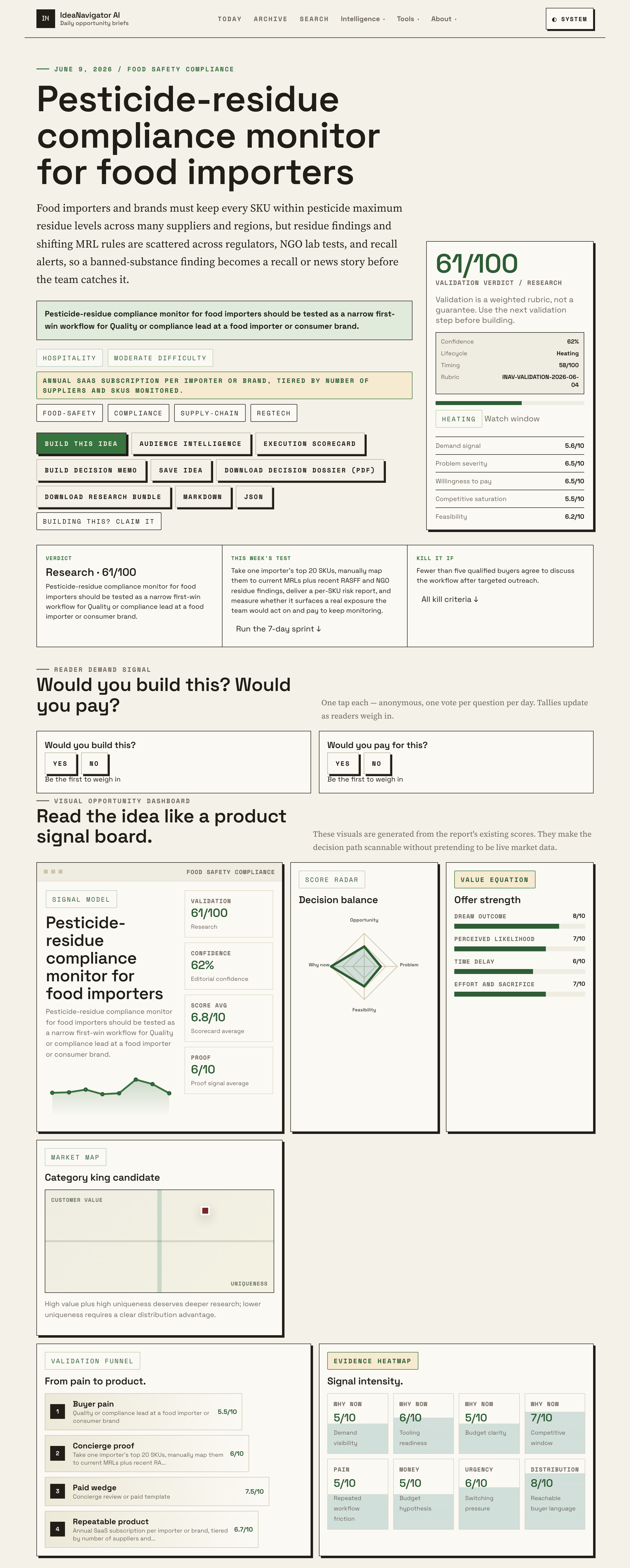
Food importers need effective pesticide-residue monitoring to ensure compliance with tightening regulations and prevent food recalls. Recent developments highlight the importance of real-time residue tracking tools.
Food safety regulators, NGOs, and retailers are increasingly emphasizing the need for robust pesticide-residue monitoring systems for imported foods, as rising detection of banned pesticides and tightening maximum residue levels (MRLs) push importers to improve compliance. This development underscores the critical role of real-time residue tracking in preventing food safety incidents and recalls.
Recent reports indicate that NGO testing agencies and regulatory bodies are frequently surfacing EU-banned pesticides in staple foods such as rice, tea, and spices, raising concerns about compliance gaps among importers. As MRL rules become more stringent across markets, food importers and brands face the challenge of continuously monitoring hundreds of SKUs across multiple suppliers and regions.
To address this, a new approach is emerging: pesticide-residue compliance monitors that map a company’s products to current EU and regional MRLs, as well as recent residue findings from NGO tests and recall alerts. These tools aim to flag products at risk of exceeding legal limits, enabling proactive compliance management. An industry source described this as a ‘first-win workflow’ for quality or compliance leads, helping them identify issues before they escalate into recalls or news stories.’
Market players are exploring SaaS-based solutions that provide audit-ready reports on SKU-specific residue risks. Validation involves testing these tools on top-selling SKUs, comparing the risk assessments generated with actual residue findings, and measuring whether they uncover real exposure risks that warrant action. The goal is to create a cost-effective, scalable system that enhances food safety and regulatory adherence.
Implications for Food Safety and Industry Compliance
Effective pesticide-residue monitoring is vital for safeguarding public health by reducing exposure to harmful substances. It also helps importers avoid costly recalls, legal penalties, and reputational damage. As residue findings and MRL standards evolve rapidly, having a real-time, comprehensive monitoring system ensures that companies can stay ahead of compliance requirements and respond swiftly to emerging risks. This shift is especially important given the increased scrutiny from NGOs and regulators, which can surface banned pesticides in widely consumed foods, potentially triggering recalls and damaging consumer trust.
pesticide residue testing kits
As an affiliate, we earn on qualifying purchases.
As an affiliate, we earn on qualifying purchases.
Growing Regulatory and NGO Pressure on Pesticide Residues
Over recent years, NGOs and regulatory agencies have intensified testing and enforcement related to pesticide residues in imported foods. Notably, NGO tests have repeatedly identified EU-banned pesticides in staples like rice, tea, and spices, prompting recalls and public concern. Meanwhile, EU and regional MRLs continue to tighten, requiring importers to adapt quickly to avoid violations. Currently, many companies lack integrated tools to monitor residue levels across their supply chains in real time, increasing the risk of non-compliance and associated consequences.
This environment has accelerated interest in developing dedicated residue monitoring solutions that aggregate data from regulators, NGO reports, and internal compliance checks, providing a clear picture of risk at the SKU level.
“Having a real-time pesticide-residue monitor helps us identify risky SKUs before they hit the shelves, saving time and avoiding costly recalls.”
— an anonymous industry expert
food safety pesticide residue monitor
As an affiliate, we earn on qualifying purchases.
As an affiliate, we earn on qualifying purchases.
Uncertainties About Implementation and Effectiveness
It remains unclear how quickly and widely these pesticide-residue monitoring tools will be adopted across the industry. There is also limited data on their long-term effectiveness in preventing residues above legal limits, and whether they can keep pace with rapidly changing MRL regulations and new residue findings. Further validation and industry feedback are needed to confirm their practical impact at scale.
regulatory compliance pesticide testing tools
As an affiliate, we earn on qualifying purchases.
As an affiliate, we earn on qualifying purchases.
Next Steps for Industry Adoption and Validation
Moving forward, industry stakeholders plan to pilot these monitoring tools on top SKUs, compare their assessments with actual residue test results, and refine algorithms to improve accuracy. Regulatory agencies and NGOs may also increase transparency and data sharing, enhancing the tools’ effectiveness. Widespread adoption could follow if these systems demonstrate consistent value in reducing violations and recalls, shaping future food safety standards.
real-time pesticide residue tracking software
As an affiliate, we earn on qualifying purchases.
As an affiliate, we earn on qualifying purchases.
Key Questions
How do pesticide-residue monitors work?
They map products to current MRLs and recent residue findings, flagging SKUs at risk of exceeding legal limits based on aggregated data from regulators, NGOs, and internal sources.
Are these tools reliable for all types of foods?
Their effectiveness depends on the quality of data inputs and the frequency of updates. Validation studies are ongoing to confirm their accuracy across different food categories.
Will implementing these monitors prevent all pesticide violations?
While they significantly reduce risk by providing early alerts, no system can guarantee zero violations. Continuous monitoring and testing remain necessary.
What are the costs involved for importers?
Most solutions are offered as tiered SaaS subscriptions, with costs varying based on the number of SKUs and suppliers monitored, generally affordable for medium to large companies.
How soon can companies expect to see results from adopting these systems?
Initial validation and pilot programs can produce actionable insights within a few months, with broader benefits emerging as the systems mature and data integration improves.
Source: IdeaNavigator AI