📊 Full opportunity report: Real-Time Driver Fatigue Alerts For Cars Lacking Advanced Safety Tech on IdeaNavigator AI — validation score, market gap, and execution plan.
TL;DR
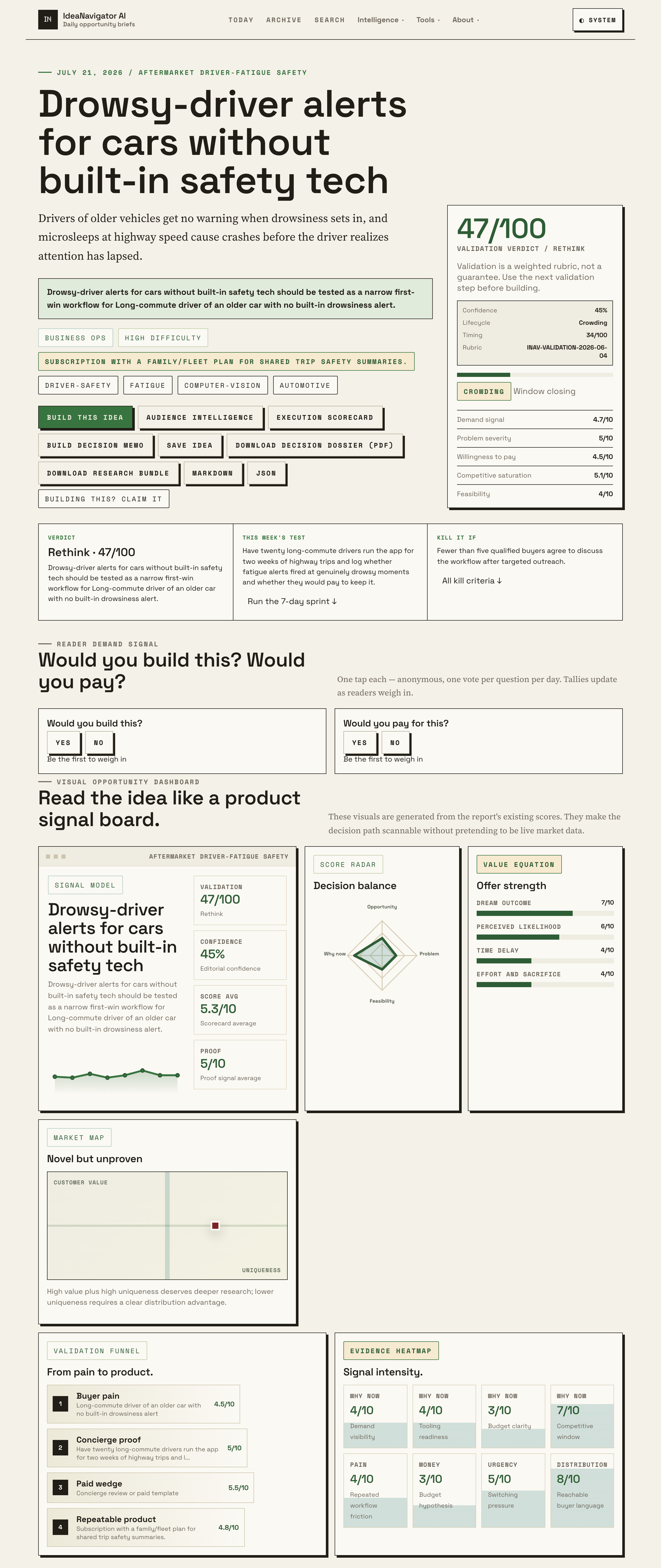
An aftermarket phone app is being tested to detect driver drowsiness in older cars without advanced safety features. The system uses phone-mounted cameras to monitor eye and head movements and alerts drivers when signs of fatigue appear. This development targets long-commute drivers and aims to improve road safety.
A new prototype app is being tested to provide real-time drowsiness alerts for drivers of older vehicles that lack built-in safety systems. The app uses a phone-mounted camera to monitor eye closure and head nodding, sounding alerts and prompting drivers to take breaks. This initiative aims to address the safety gap for drivers of non-equipped vehicles, especially during long commutes.
The app, developed as an aftermarket solution, leverages cheap dashboard phone mounts and on-device face-landmark models to estimate driver fatigue signs. It is designed for long-commute drivers who drive older cars without integrated drowsiness detection systems. The initial testing involves twenty drivers who will use the app over two weeks of highway trips, with data collected on alert accuracy and user acceptance.
According to sources, the app detects signs such as eye-closure and head-nodding, escalating alerts if fatigue persists. The goal is to prevent microsleeps, which often occur at highway speeds and lead to crashes before drivers recognize their drowsiness. The app also offers a take-a-break prompt, encouraging drivers to rest when necessary.
Market analysts see this as an important step in aftermarket driver safety, filling a gap left by the lack of built-in safety tech in older vehicles. Revenue models include subscription plans for individual users and fleet management options, with shared safety summaries for families or commercial drivers.
Potential Impact on Road Safety for Older Vehicles
This development could significantly reduce highway accidents caused by driver fatigue, especially among drivers of older cars that lack advanced safety features. By providing a low-cost, easy-to-install solution, it offers an accessible safety upgrade for a large segment of drivers who are otherwise unprotected from drowsiness-related crashes. If successful, it could lead to broader adoption of aftermarket fatigue detection systems, influencing safety standards and regulations.
driver fatigue detection app for older cars
As an affiliate, we earn on qualifying purchases.
As an affiliate, we earn on qualifying purchases.
Growing Need for Aftermarket Driver Safety Solutions
Most new vehicles now come equipped with built-in drowsiness detection systems that monitor eye movements and head position. However, older cars often lack such features, leaving drivers vulnerable. The concept of using smartphone-based face-landmark models to estimate fatigue is gaining traction as a practical workaround. Past efforts have focused on in-vehicle sensors, but the high cost and retrofit challenges limit widespread adoption.
Recent technological advances, including affordable phone mounts and face-tracking algorithms, make it feasible to develop effective aftermarket solutions. The idea is to provide a simple, non-invasive system that can be used by drivers of any vehicle, especially those undertaking long commutes where fatigue risk is highest.
“Using phone-mounted cameras to monitor eye-closure and head movements offers a promising way to detect driver fatigue in older vehicles.”
— an anonymous researcher
phone mount with camera for driver alert
As an affiliate, we earn on qualifying purchases.
As an affiliate, we earn on qualifying purchases.
Unconfirmed Effectiveness and User Acceptance
It is not yet clear how accurately the app will detect drowsiness in real-world conditions or whether drivers will accept and consistently use the system. The testing phase is ongoing, and results are awaited to confirm alert reliability and user engagement.
driver drowsiness alert system
As an affiliate, we earn on qualifying purchases.
As an affiliate, we earn on qualifying purchases.
Next Steps in Testing and Potential Deployment
The current phase involves collecting data from twenty long-commute drivers over two weeks. Based on the results, developers will refine the detection algorithms and evaluate user feedback. If successful, a commercial version could be available within the next 12 months, with broader market adoption depending on regulatory and consumer response.
aftermarket driver safety device
As an affiliate, we earn on qualifying purchases.
As an affiliate, we earn on qualifying purchases.
Key Questions
How does the app detect driver fatigue?
The app uses a phone-mounted camera to monitor facial features, specifically eye-closure and head movements, to identify signs of drowsiness.
Will this work in all types of vehicles?
Yes, since it relies on a smartphone app and camera, it can be used in any vehicle without built-in safety tech.
Is this a replacement for built-in safety systems?
No, it is an aftermarket solution intended to supplement safety, especially for older cars lacking integrated drowsiness detection.
When will this app be available commercially?
The current testing phase aims to refine the system, with a potential commercial rollout within the next year, depending on results and regulatory approvals.
Are there privacy concerns with this app?
The app processes facial data locally on the device to minimize privacy risks, but user acceptance and data security measures will be key considerations before wider deployment.
Source: IdeaNavigator AI