
📊 Full opportunity report: Social Media Management Software That Keeps Work On Track on IdeaNavigator AI — validation score, market gap, and execution plan.

Get business pricing on office and shipping supplies
- Business-only prices and quantity discounts
- Tax-exempt purchasing
- Multiple users, one account, clear invoices
TL;DR
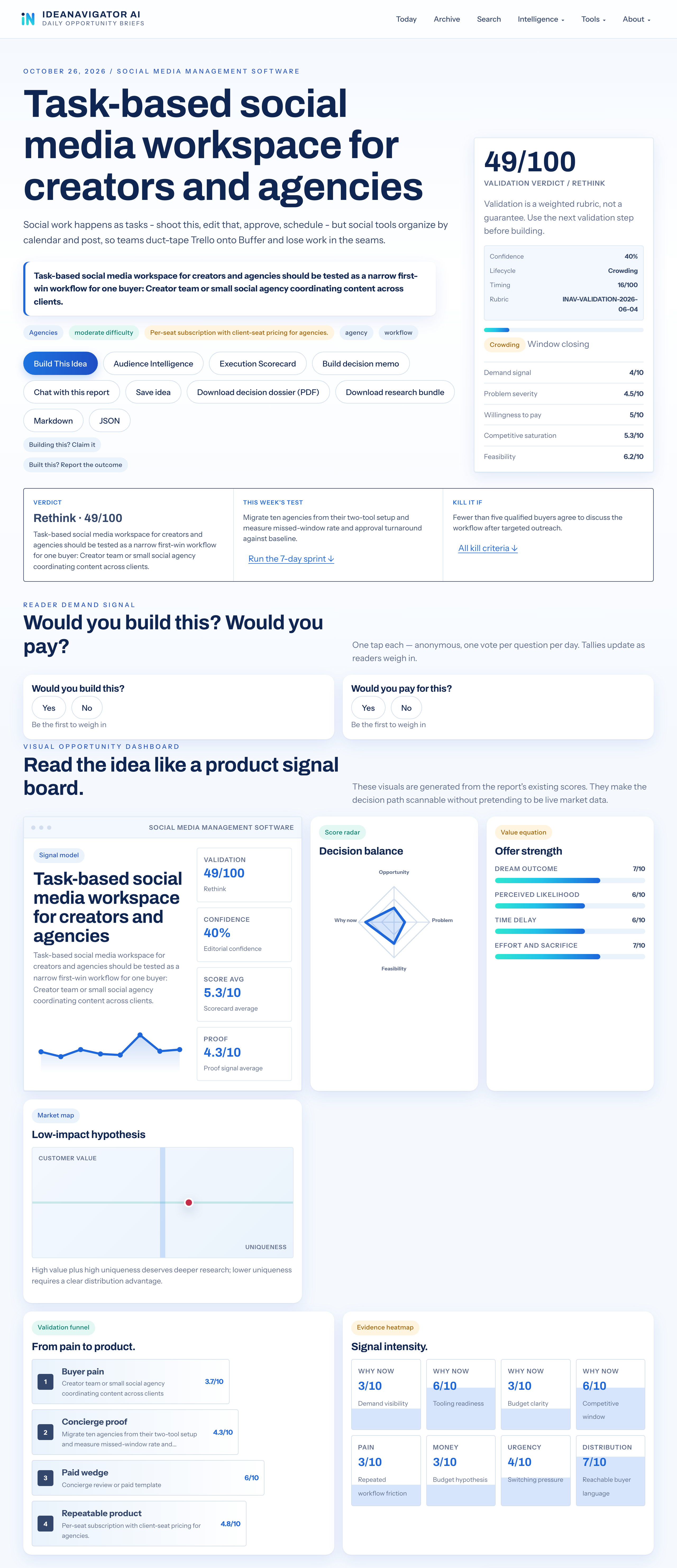
IdeaNavigator AI has outlined a product opportunity for a task-based social media workspace aimed at creator teams and small agencies managing multiple clients. The proposal would bring post production, client approvals and scheduling into one workflow, but it is an idea to validate—not a launched product or proven market result.
IdeaNavigator AI has outlined a proposed task-based workspace for creator teams and small social agencies coordinating content for multiple clients. The concept would connect post briefs, asset creation, editing, approval and scheduling in one pipeline, addressing a workflow gap the proposal identifies between social scheduling tools and generic project-management software; no product launch or test results are reported.
The proposed workspace treats each social post as a task, rather than organizing work mainly around a publishing calendar. Its suggested stages are brief, asset, edit, approval and scheduled. The concept also includes client-facing approval links and asset versioning, with scheduling triggered once a post receives approval.
IdeaNavigator AI frames the product for a specific initial buyer: creator teams and small social agencies that coordinate content across clients. The problem it identifies is that production involves several handoffs—such as filming, editing, client review and scheduling—while teams may use one tool for publishing and another for task tracking. Work can be lost between those systems, according to the proposal.
The suggested business model is a per-seat subscription, with separate client-seat pricing for agencies. To test demand and performance, the proposal recommends migrating ten agencies from their existing two-tool setups and comparing missed publishing windows and approval turnaround times against each agency’s baseline. No agencies, measured results, pricing figures or implementation details are identified.
A Workflow Test for Small Agencies
The concept targets a practical coordination problem: social content requires work to move through production and review before it can be published. If task status, assets, client feedback and scheduling sit in separate systems, teams may need to update records in multiple places or chase approvals manually. A shared pipeline could make ownership and the next step for each post easier to see, though the proposal does not establish that a new workspace would reduce missed deadlines.
For small agencies, the idea also ties product value to client review and handoffs, rather than scheduling alone. Approval links and client seats could give clients a defined way to review work without making them full workspace users. Whether agencies would pay for this arrangement, and whether clients would adopt it, remain questions for testing.
The proposed pilot focuses on two measurable outcomes: missed-window rate and approval turnaround. Those measures could help distinguish a useful workflow improvement from a tool that merely consolidates features. Until a test is completed and its methods and results are reported, the concept should be treated as a product hypothesis, not evidence of improved performance.
Popular right now

Dyson V9 Motorbar Cordless Vacuum

TCL 55-Inch F7D Series QLED 4K UHD Smart Fire TV (2026)

Ninja Luxe Café Premier 3-in-1 Espresso Machine, Drip Coffee & Cold Brew
As an affiliate, we earn on qualifying purchases.
From Calendars to Production Tasks
Social media management software commonly centers on planning and publishing posts. The proposal argues that this leaves production work—briefing, preparing assets, editing and collecting approvals—to general-purpose project tools or informal processes. Its suggested product would place those activities alongside post scheduling in a single workflow.
The timing rationale in the proposal is that rising content expectations have increased the amount of coordination involved in social work, while established scheduling products have not necessarily provided a full work-management layer. These are market assertions made in the concept; the material gives no industry-wide figures, named competitors, customer survey or independent data to quantify the gap.
Rather than recommending a broad launch, IdeaNavigator AI proposes beginning with one narrow buyer group and testing the workflow with ten agencies already using two tools. This focus could help determine whether consolidating production and scheduling addresses a recurring problem before a larger product is built.
Pilot Results and Product Details
No launched product, working prototype or completed agency pilot is described. The ten-agency test is a validation recommendation, not a reported study, and there are no baseline values or findings for missed publishing windows or approval speed.
Other details are also unspecified, including product ownership, development timeline, supported social platforms, integrations, security and permissions, and the subscription price. It is not clear how approval links would handle revision requests, how asset versions would be stored, or whether scheduling would connect directly to each platform. The proposal also supplies no customer interviews or evidence that agencies would replace their current tools.
Testing the Agency Workflow
The next step set out in the concept is to recruit ten agencies, move their work from a two-tool setup into the proposed workflow and record baseline measures before comparing results. A meaningful assessment would need to define missed windows and approval turnaround consistently, account for differences between agencies, and report how many teams completed the test.
Any follow-up would need to establish whether the workflow is practical in day-to-day client work and whether agencies would pay for it. No test schedule or launch date has been announced, so whether the concept advances to a product remains open.
Source: IdeaNavigator AI
Key Questions
Is this a launched social media management product?
No. The available information describes a product concept and proposed validation test, not a released product or confirmed launch.
Who is the proposed workspace for?
It is aimed at creator teams and small social agencies coordinating content across multiple clients.
What would the workspace include?
The proposal describes post tasks moving through brief, asset, edit, approval and scheduled stages, with client approval links, asset versioning and scheduling after approval.
How would the idea be tested?
IdeaNavigator AI proposes moving ten agencies from their current two-tool setups and comparing missed publishing windows and approval turnaround with baseline measurements. No test results are available.
How would the product make money?
The suggested model is a per-seat subscription, with client-seat pricing for agencies. Actual prices have not been stated.
Source: IdeaNavigator AI