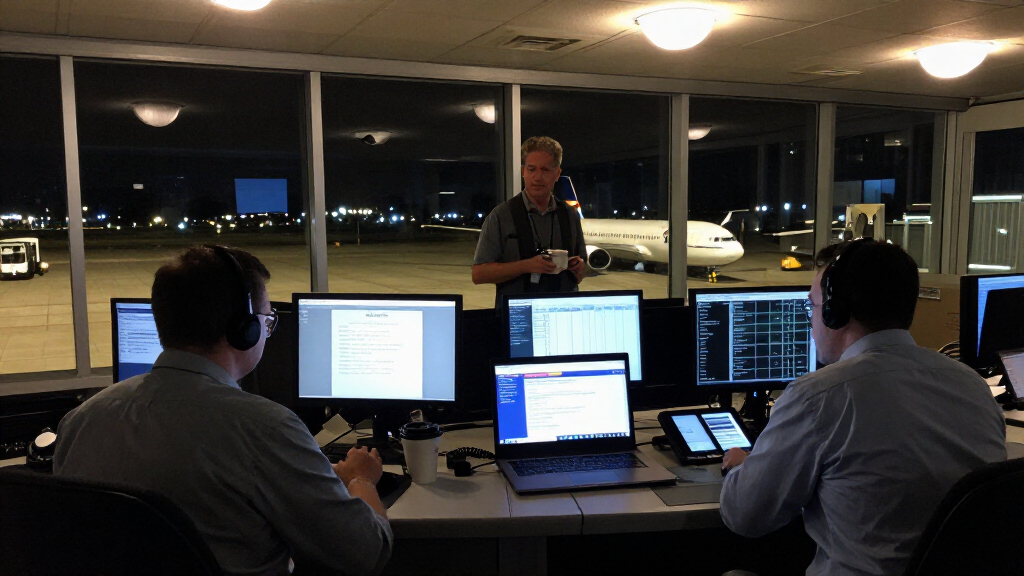
🔍 Read the full analysis: Breaking Down A Week Of US Tech Outages Affecting Banks, Flights, Email, And The NSA on ThorstenMeyerAI.com

Get business pricing on office and shipping supplies
- Business-only prices and quantity discounts
- Tax-exempt purchasing
- Multiple users, one account, clear invoices
TL;DR
Six outages from Nov. 12 to Nov. 17 disrupted Microsoft 365 email, U.S. air travel, JPMorgan Chase transactions, United Airlines operations, Apple services and an NSA network. The organizations have cited separate technical problems or maintenance, and officials say they have no evidence the incidents were cyberattacks or connected; investigations remain incomplete.
Six technology outages disrupted email, U.S. flights, bank transactions and other services between Nov. 12 and Nov. 17, but the organizations involved have so far described separate technical problems or scheduled maintenance, not a coordinated attack. U.S. officials said they had no evidence linking the incidents, while investigations into several remain incomplete.
The incidents affected Microsoft 365 on Nov. 12, a Federal Aviation Administration network on Nov. 13, JPMorgan Chase customers and United Airlines operations on Nov. 16, and Apple services and an internal National Security Agency network on Nov. 17, according to accounts summarized by ThorstenMeyerAI.com. The disruptions touched services used by businesses, travelers and consumers, as well as government systems.
Microsoft has published the most detailed technical account so far. Its preliminary report said a software defect introduced in a change whose deployment began in July caused Windows servers to become unresponsive under some load conditions. The failure spread after traffic shifted to a primary networking gateway, while about 14% of gateway server capacity was already unavailable. Microsoft said more than 80% of servers were unresponsive at the outage’s lowest point. Its status record places the disruption from 16:20 UTC Nov. 12 to 16:10 UTC Nov. 13, a total of 23 hours and 50 minutes.
The FAA said data flooded its network at a rate of 1,000 connection attempts every four to five seconds, destabilizing legacy equipment. Its initial investigation pointed to work at a radar site in Amarillo, Texas, and a radio site in El Dorado, Arkansas. The FAA’s count for Friday was approximately 12,462 flights affected, including 9,082 cancellations by major airlines; that figure does not mean every flight disruption was directly caused by the ground stop.
For the other incidents, the public explanations are less detailed. JPMorgan Chase attributed its disruption to “a software bug in on-premise hardware systems.” United Airlines called its problem “a technology issue,” while Apple described an “internal update.” The NSA said its outage involved “scheduled routine maintenance”; Director of National Intelligence Jay Clayton tied it to security patching. Those descriptions are the organizations’ stated causes, not independently established technical findings.
Disruptions Across Essential Services
The outages show how failures in technology systems can quickly affect services beyond the system that initially breaks. A mail disruption can interfere with calendars and collaboration tools; an airline’s operational data problem can delay departures; and a payment issue can leave customers temporarily unable to complete transactions. In the FAA incident, the agency’s nationwide ground stop lasted four hours and 23 minutes, according to the times in its advisory, while flight cancellations and delays continued to ripple through the travel system.
The shared lesson supported by the available accounts is not that one cause explains every outage. It is that changes to live systems and dependencies on shared infrastructure can create broad effects when a defect, capacity shortfall or compatibility problem surfaces. The specific risks differ by organization, and the public record is not detailed enough to establish a single pattern across all six.
For businesses, the disruptions underline the value of identifying services that depend on a single vendor or system and preparing alternatives for communications and payments. For individuals, keeping another payment method available and storing essential information offline can help during temporary service interruptions. These are practical precautions, not indications that further outages or attacks are expected.
Popular right now

De'Longhi Magnifica Duo Fully Automatic Espresso Machine with Milk Frother, Silver

KitchenAid Artisan 5-Quart Tilt-Head Stand Mixer with Flex Edge Beater

Dyson V9 Motorbar Cordless Vacuum
As an affiliate, we earn on qualifying purchases.
How the Outages Unfolded
The week began with Microsoft 365 email problems on Thursday, Nov. 12. According to Microsoft’s preliminary report, Exchange Online and services that rely on it were affected. The company said the underlying defect had been introduced months earlier, while the gateway and capacity conditions helped turn the defect into a wider failure. Microsoft said a final report was due Nov. 20.
On Friday, Nov. 13, the FAA issued a ground stop covering U.S. airports. The agency’s written account linked instability in legacy equipment to a surge of connection attempts on its FAA Telecommunications Infrastructure network. Flight disruption extended beyond the period of the stop. NPR, citing FlightAware, reported nearly 25,000 delays and more than 9,000 cancellations on Friday; those figures reflect the broader day’s disruption, not a count of flights caused solely by the ground stop.
Further disruptions followed Monday and Tuesday. JPMorgan Chase customers reported stalled transactions, and United could not send pilots final aircraft weight information needed before takeoff, according to the source report. Apple’s iCloud and App Store services faltered, and an NSA internal network went down. The report describes the NSA network as classified; the public information does not detail the systems or work affected.
““We have zero evidence whatsoever, we have no indication, no evidence, and no reason to believe at all that any of these incidents are related to each other.””
— U.S. Secretary of State Marco Rubio, speaking in Manila, as quoted by ThorstenMeyerAI.com
Investigations Still Incomplete
No evidence of a shared attack has been reported by the organizations or officials cited in the source material. That is the current public assessment, not proof that every investigation is finished. Rubio said officials had no reason to believe the events were related, and the organizations have given different explanations. The available accounts do not establish a connection among them.
Important details remain unavailable. Microsoft’s account is preliminary, and its final report had not yet been released as of the stated reporting cutoff. The FAA described its investigation as initial and identified two sites where a contractor had been deploying equipment, but the supplied material does not specify the complete technical sequence or final findings. Public explanations for the JPMorgan Chase, United and Apple disruptions are brief, and no detailed technical reports are provided. The full operational scope and recovery details for the NSA network also remain unclear.
Clayton’s comments about institutions applying security patches offer a possible general explanation for why systems may be vulnerable during maintenance. They should not be read as confirmation that patching caused the bank, airline or Apple incidents. At this stage, the confirmed commonality is limited: each organization described a problem involving its own systems, and several accounts involved changes or maintenance.
Final Reports and Recovery Details
The next stated milestone is Microsoft’s final post-incident report, expected Nov. 20. It may clarify how the software defect, gateway failover and unavailable capacity interacted, though the source material does not say whether Microsoft will publish additional details beyond that report.
The FAA’s investigation may provide more information about the data surge and the equipment work at the Texas and Arkansas sites. The other organizations could also release fuller technical explanations, but no publication dates or commitments are included in the available material. Until then, claims about a common cause or deliberate coordination remain unsupported by the evidence described so far.
Key Questions
Were the six outages caused by a coordinated cyberattack?
No evidence of a coordinated attack or link has been reported in the source material. Rubio said officials had no reason to believe the incidents were related, but investigations were still ongoing.
Which outage has the clearest public explanation?
Microsoft 365 has the most detailed account so far. Microsoft’s preliminary report described a latent software defect, traffic shifting to a primary gateway and about 14% of gateway capacity being unavailable.
What did the FAA say caused the flight disruption?
The FAA said data flooded its network at 1,000 connection attempts every four to five seconds, destabilizing legacy equipment. Its initial investigation pointed to work at a radar site in Amarillo, Texas, and a radio site in El Dorado, Arkansas.
Did the FAA ground stop account for every flight cancellation?
No. The FAA reported approximately 12,462 flights affected on Friday, including 9,082 cancellations, but said the count was not limited to flights directly caused by the ground stop.
What happens next?
Microsoft’s final report was due Nov. 20, 2026. Further technical findings from the FAA and the other affected organizations had not been announced in the information available as of Nov. 18.
Source: ThorstenMeyerAI.com