📊 Full opportunity report: A Smarter Starting Point For SMB Automation: Workflow Audits on IdeaNavigator AI — validation score, market gap, and execution plan.

Get business pricing on office and shipping supplies
- Business-only prices and quantity discounts
- Tax-exempt purchasing
- Multiple users, one account, clear invoices
TL;DR
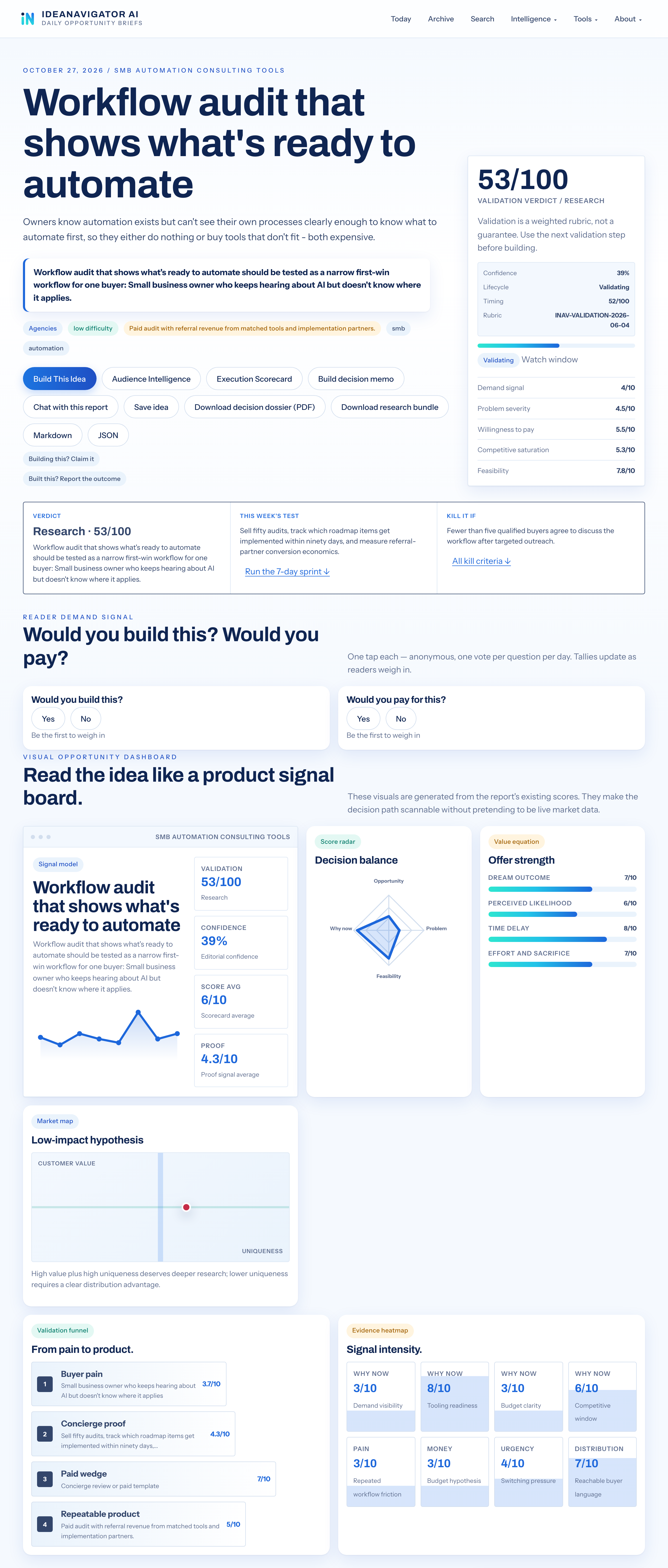
IdeaNavigator AI proposes a guided workflow audit to help small-business owners identify which processes may be suitable for automation. The proposed product would score workflows, recommend tools and set out a 90-day roadmap; the concept has not been validated with customer results.
IdeaNavigator AI has proposed a paid workflow-audit service designed to help small-business owners decide where automation may fit, responding to a problem the proposal identifies: owners hear about AI tools but may not know which parts of their operations are suitable. The concept would turn an interview about business processes into a scored map, suggested tools and a 90-day implementation roadmap, but no launch, sales or performance results are reported.
According to IdeaNavigator AI’s proposal, the audit would guide an owner through how the business operates, then organize the answers into a process map. Each workflow would receive assessments for automation readiness, potential return on investment and difficulty. The output would sequence possible changes over 90 days and pair each step with suggested tools. The proposal does not specify a scoring formula, the information an owner would need to provide or how recommendations would be checked.
IdeaNavigator AI says the concept targets small-business owners who know automation is available but lack a clear view of their own processes. The proposal describes two potential costs of that uncertainty: doing nothing despite possible opportunities, or buying tools that do not suit the work. These are the proposal’s assessment of the problem, not findings from a customer survey or a measured study.
The proposed business model, as outlined by IdeaNavigator AI, combines payment for the audit with referral revenue from recommended software and implementation partners. To test the idea, the proposal calls for selling 50 audits, tracking which recommended roadmap items customers implement within 90 days, and measuring conversion economics for referral partners. It provides no price, sales channel, partner list or results from that test.
A Practical Test for Automation Demand
The proposal addresses a real decision point for owners: automation advice is less useful if a business cannot identify the repetitive tasks, handoffs or delays that might be improved. A structured audit could give owners a starting sequence rather than a broad list of products. Its usefulness would depend on whether the interview captures the actual work accurately and whether its recommendations reflect the business’s budget, systems and capacity to make changes.
The proposed approach also links advice to implementation. Tracking whether customers act on roadmap items within 90 days could reveal whether the audit produces recommendations owners can use, while referral tracking could show whether partner introductions lead to commercial activity. Those measures would offer more evidence than interest in AI tools alone. At present, however, they are proposed validation measures, not established outcomes.
For readers considering similar services, the distinction between an audit and a guaranteed efficiency gain matters. A readiness score or tool match would be a recommendation, not proof that automation will save money or time. The concept’s value would need to be judged against implemented changes and their results, with costs and practical constraints accounted for.
Popular right now

Samsung 42-Inch Class OLED S90F 4K Smart TV (2025)

Dyson V8 Cyclone Cordless Vacuum

Shark Navigator Lift-Away Upright Vacuum (NV360)
As an affiliate, we earn on qualifying purchases.
From AI Interest to Process Mapping
IdeaNavigator AI frames the opportunity around the rapid expansion of AI tools and the resulting difficulty of choosing among them. Its proposal says guided process-mapping interviews may now be automated with large language models, making it possible to gather operational details and turn them into a structured assessment. It does not provide technical evidence, examples of an interview, or comparisons with existing consulting services.
The proposed product is an early-stage concept rather than a confirmed market launch. Its intended market is small-business automation consulting tools, and its first audience is owners who are unsure where AI applies. The suggested narrow first test—selling 50 audits—would help establish whether customers will pay for this type of assessment before a broader offering is built.
Pricing, Accuracy and Results Remain Open
IdeaNavigator AI’s proposal does not describe an operating product, completed audit, customer interview, sale or implementation result. It is unclear how the service would set prices, protect sensitive business information, verify owner responses or distinguish tasks that are technically automatable from tasks that are appropriate to automate.
The proposal also does not explain how it would calculate potential ROI, account for software and implementation costs, or handle recommendations that depend on human judgment and exceptions. Its referral model could create incentives to favor partner tools, but no safeguards or disclosure approach are specified. These details would matter to owners deciding whether to trust the audit’s rankings and recommendations.
The Proposed 50-Audit Validation
IdeaNavigator AI’s proposal identifies selling 50 audits and following the recommended roadmap items for 90 days as the next step. The test would track which suggestions are implemented and assess referral-partner conversion economics. The proposal gives no schedule, launch announcement or recruitment process for those customers, so it is not clear when—or whether—the test will begin.
If conducted, the trial could indicate whether owners pay for the assessment, whether recommendations lead to action and whether partner referrals produce revenue. Those results would help determine whether to refine the interview, scoring system or tool-matching process. Until such evidence is reported, the audit remains a proposed starting point for SMB automation, not a demonstrated solution.
Source: IdeaNavigator AI proposal
Key Questions
What is the proposed workflow audit?
IdeaNavigator AI describes it as a proposed guided interview for small-business owners. The service would map business processes, score them for automation readiness, potential ROI and difficulty, and suggest tools and a 90-day sequence of steps.
Is the audit available now?
IdeaNavigator AI’s proposal does not report a product launch, availability date or completed customer sales. It describes a concept and a suggested validation test.
How would the service make money?
The proposal outlines a model combining payment for the audit with referral revenue from matched tools and implementation partners. Pricing and partner arrangements are not specified.
How would the idea be tested?
IdeaNavigator AI recommends selling 50 audits, then tracking which roadmap recommendations customers implement within 90 days and measuring referral-partner conversion economics. The proposal reports no test results.
Source: IdeaNavigator AI