🔍 Read the full analysis: Using AI To Design And Print Parts: What To Expect on ThorstenMeyerAI.com

Get business pricing on office and shipping supplies
- Business-only prices and quantity discounts
- Tax-exempt purchasing
- Multiple users, one account, clear invoices
TL;DR
AI is already used to optimize some engineering designs and detect certain errors during 3D printing, but it does not make a part trustworthy on its own. NASA examples and a University of Cambridge printer-monitoring system show practical uses, while testing, careful specifications and human judgment remain necessary.
AI can help engineers optimize part shapes and help printers detect some problems as they happen, but it cannot yet turn a text prompt into a part that can be trusted without review and testing, according to a November 29 explainer from ThorstenMeyerAI.com. The report follows a part from design through printing, using NASA engineering work and a University of Cambridge monitoring system to distinguish current applications from more speculative text-to-CAD claims.
The clearest example in the report is generative design, in which an engineer specifies a part’s connections, loads and areas that must remain clear, then software proposes a shape. NASA Goddard research engineer Ryan McClelland used commercial software to develop a bracket for the EXCITE balloon telescope. His paper, as summarized by ThorstenMeyerAI.com, says two engineers spent two days on a conventional design; encoding requirements for the software took one engineer about 30 minutes, followed by roughly an hour of computing. Those are reported timings for this case, not a general measure of time saved.
The method, called topology optimization, repeatedly evaluates how forces travel through a design and removes material judged to carry little load. That can produce lightweight structures, but the result depends on the constraints and assumptions entered by the engineer. The source report says McClelland cautions that the algorithm can sometimes make structures too thin. NASA’s AI-designed parts still undergo stress analysis and testing, rather than being accepted on the software’s output alone.
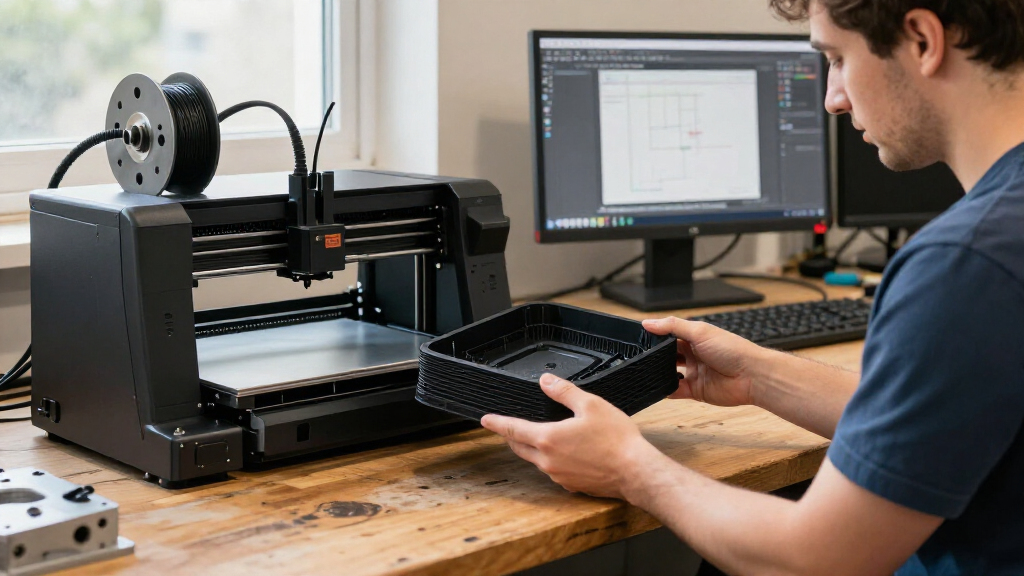
AI is also being used to monitor some material-extrusion printers, which melt plastic filament and deposit it through a nozzle. The report describes a University of Cambridge system trained to recognize and correct common nozzle errors while printing. It presents camera-based monitoring as a way to catch problems during production, not as proof that every defect can be detected or that the completed part is safe. Text-to-CAD systems, meanwhile, remain research-stage in the report’s assessment: software producing runnable code does not establish that the resulting geometry is correct or fit for use.
From idea to printed part: where AI looks over your shoulder
The orange marker shows where AI helps today. The last word still belongs to a real test.
Design: you set the loads, bolts and keep-out zones. The software proposes the shape.
Check: simulation predicts how the part bends. Only a real test shows how strong it is.
Print: a camera next to the nozzle spots common errors and corrects them during the print.
Every step: AI guesses from patterns. For parts that carry weight, people still test.
Where AI Can Change Part Production
For engineers, generative design can reduce time spent exploring shapes, particularly when a part has defined loads and connection points. But the software solves the problem it is given. If a brief omits a bolt, a required clearance, a load case or the space a person needs to reach a component, an apparently polished design may still be wrong. Human specification and review remain part of the engineering work.
For home users, printer cameras and error detection may be the most visible near-term application. A monitoring system could alert someone to a failed first layer or a nozzle problem before more material is wasted. The report advises treating such tools as an extra set of eyes, not a guarantee; users still need to inspect prints, especially early layers.
The stakes rise when a part carries weight, protects people or is used in flight. Software estimates and visual monitoring cannot replace physical testing of the finished component. The report points to NASA’s standards for printed flight hardware as an example of the controls involved in safety-critical applications.
Popular right now

Roborock F25 BX Cordless Wet/Dry Vacuum Cleaner

Dreame G10 Pro Wet-Dry Vacuum Mop

Shark HydroVac MessMaster Cordless Wet Dry Vacuum and Mop Combo, AW261
As an affiliate, we earn on qualifying purchases.
From CAD Model to Printed Part
A printed part typically passes through several stages. An engineer first creates a dimensioned model in computer-aided design (CAD), then checks how it may respond to forces. A slicer converts the model into layers and machine instructions, often called G-code, and the printer follows those instructions to build the object layer by layer. AI can assist at different points, but those stages do not collapse into a single reliable prompt-to-part process.
The report focuses on material extrusion for its printer-monitoring example. The U.S. National Institute of Standards and Technology describes material extrusion as a method commonly used by personal and commercial 3D printers; Cambridge researchers cited in the report call it the most widespread additive-manufacturing method. Other common approaches include curing liquid resin with ultraviolet light and using lasers or electron beams to fuse powder. Capabilities demonstrated on a nozzle printer should not automatically be assumed to apply to every process.
Printing also involves iteration. The NASA paper cited by the report says it is common to repeat additive-manufacturing work after unexpected failures. That is why a digital model or a successful print sequence is not, by itself, evidence that a part will perform as intended under real conditions.
What AI Tools Cannot Yet Prove
The source report does not establish how reliably the Cambridge system detects different defects across printers, materials or operating conditions, or how widely it is available. It also gives no broad performance comparison for generative-design software across industries. The NASA bracket timings are one reported example and should not be read as a typical result.
Text-to-CAD remains a particular uncertainty. A model or script that runs may still contain incorrect dimensions, omit a necessary feature or produce geometry that cannot be manufactured as intended. The report says there is not yet a basis for treating sentence-to-part output as trustworthy without human checks. It also notes that U.S. copyright and patent rules constrain how purely AI-generated work is treated: its account says purely AI-made output receives no U.S. copyright and only humans can be named as inventors. The precise application of those rules depends on the work and circumstances; the report does not resolve individual cases.
Most importantly, neither a successful simulation nor a printer’s error alert confirms that a load-bearing or safety-related part will perform safely. The source provides no basis for waiving the testing and inspection required for a particular application.
More Testing Before Wider Trust
The immediate next step for users is to apply these tools within existing engineering and production checks: define requirements carefully, review generated geometry, inspect prints and test parts for their intended use. NASA’s cited practice—stress analysis and testing of AI-designed hardware—shows that generative design is being used as part of an engineering process, not as a replacement for it.
Further evidence will be needed to show how well printer-monitoring systems work across different machines and conditions, and whether text-to-CAD tools can consistently produce manufacturable, dimensionally correct parts. Until those capabilities are demonstrated for a specific use, the practical expectation is AI assistance with human responsibility: software may suggest, optimize or flag, while people remain accountable for checking the design and the finished part.
Key Questions
Can AI design a 3D-printed part from a sentence?
Not reliably enough to trust without review, according to the source report. Text-to-CAD is described as research-stage; working code does not prove that the part’s shape or dimensions are correct.
What does generative design do?
It proposes shapes after an engineer defines requirements such as loads, attachment points and areas that must stay clear. The engineer still needs to check whether the assumptions and resulting design are suitable.
Can an AI camera guarantee a successful print?
No such guarantee is established in the report. A camera system may identify and correct some common nozzle errors, but users still need to inspect the print and assess the finished part.
Do AI-designed parts still need testing?
Yes. The report says NASA subjects its AI-designed parts to stress analysis and testing. Parts that carry loads or affect safety need checks appropriate to their intended use.
How much time can generative design save?
One NASA bracket example took two engineers two days using a conventional approach; the reported software-assisted process involved about 30 minutes of requirement encoding and roughly an hour of computing. That single case does not establish typical time savings.
Source: ThorstenMeyerAI.com