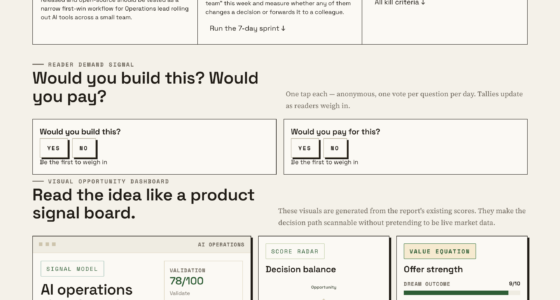

📊 Full opportunity report: Waves, Not a Wall: Inside DeepMind’s Map From AGI to Superintelligence on ThorstenMeyerAI.com — validation score, market gap, and execution plan.

Get office and shipping supplies delivered free — and shop member deals
- Fast, free delivery on millions of items
- Access to Prime Big Deal Days deals on October 6–7
- Prime Video, Amazon Music and more included
TL;DR
DeepMind researchers released a comprehensive report mapping the progression from artificial general intelligence (AGI) to superintelligence (ASI). The report highlights four potential pathways and discusses scaling laws, paradigm shifts, and inherent limits. The development offers a structured approach to understanding AI’s future but leaves many uncertainties about the timeline and technical feasibility.
DeepMind researchers released a detailed 57-page report on June 10, outlining a structured framework for understanding the transition from artificial general intelligence (AGI) to superintelligence (ASI). The report emphasizes that this progression is likely to involve multiple parallel pathways, including scaling, paradigm shifts, recursive self-improvement, and multi-agent systems, while also acknowledging significant technical and theoretical limits. This framework aims to guide future research and policy discussions on AI development.
The report, authored by a team of fourteen researchers including Shane Legg and Marcus Hutter, offers a conceptual map rather than experimental results. It defines four key stages: today’s AI, human-level AGI, ASI, and a theoretical ceiling called Universal AI, anchored to the Legg-Hutter score—a formal measure of intelligence based on performance across all computable tasks.
The authors set a high bar for superintelligence, defining it as an AI that can outperform large groups of human experts across nearly all domains, surpassing organizations rather than individuals. Their core argument is that advances in compute—driven by decreasing hardware costs, rising investments, and more efficient algorithms—will enable the rapid scaling of AI capabilities, potentially reaching ASI within the next decade if current trends continue.
They identify four pathways toward ASI: scaling existing models with more data and compute; paradigm shifts involving new architectures or training methods; recursive self-improvement, where AI accelerates its own development; and multi-agent collectives that emerge as a form of superintelligence through coordinated interactions among many AI agents. Each pathway is considered plausible, likely to operate in parallel, but also faced with significant barriers such as data limitations, verification challenges, and physical or economic constraints.
The report emphasizes that ASI would not be omniscient or omnipotent; fundamental physical and computational limits—such as the speed of light, thermodynamic constraints, and unresolved computational complexity problems—set hard boundaries on what AI can achieve.
Waves, not a wall: the road past AGI
A 57-page DeepMind report maps how AI might keep advancing after human-level AGI. Its headline: the future may not be one big “step change,” but a series of transformative waves — under enormous uncertainty.
A careful, sober map that resists both doom and rapture — and refuses to promise the usual singularity miracles. But it’s a position paper from a party with a stake in the destination, anchored to its own authors’ theory, and it deliberately brackets the economics, labor, and how humans fit in — the part that matters most. Useful terrain map; drawn by people who own the land.
Implications for AI Research and Safety
This framework provides a structured way to think about AI progress, highlighting the importance of understanding multiple pathways to superintelligence and the potential risks involved. By defining clear stages and pathways, it informs both researchers and policymakers about the technical challenges and the urgency of developing safety measures aligned with different development trajectories. The emphasis on inherent limits also tempers expectations and underscores the need for careful planning as AI approaches these thresholds.
As an affiliate, we earn on qualifying purchases.
Background on AI Progress and Theoretical Foundations
The report builds on decades of AI research, including the Legg-Hutter formalization of intelligence and recent trends in scaling large models like GPT and DeepMind’s Alpha series. It reflects a growing consensus that compute and data are primary drivers of AI capabilities, but also recognizes the limits of current architectures. Historically, AI development has oscillated between scaling approaches and paradigm shifts, and this report attempts to synthesize these trends into a coherent map of future possibilities. The authors’ focus on the transition from AGI to ASI addresses a key concern in the field: how to prepare for, and potentially control, the emergence of superintelligence.
“Our framework aims to clarify the pathways and barriers toward superintelligence, emphasizing that progress is not linear or guaranteed.”
— Shane Legg
machine learning model training GPU
As an affiliate, we earn on qualifying purchases.
As an affiliate, we earn on qualifying purchases.
Unresolved Questions About AI Development Timelines
While the report offers a detailed conceptual map, many details remain uncertain. The exact timeline for reaching ASI depends on technological breakthroughs, resource availability, and unforeseen scientific challenges. Additionally, the feasibility of recursive self-improvement at scale and the emergence of multi-agent superintelligence are still speculative. The authors acknowledge these uncertainties and stress the need for ongoing research to clarify these pathways and develop safety measures.
AI research books on superintelligence
As an affiliate, we earn on qualifying purchases.
As an affiliate, we earn on qualifying purchases.
Next Steps for Researchers and Policymakers
Researchers are expected to explore the outlined pathways further, especially focusing on the technical feasibility of recursive self-improvement and multi-agent systems. Policymakers and safety experts should consider the framework when developing regulations and safety protocols, ensuring preparedness for different development scenarios. Continued monitoring of compute trends, data availability, and architectural innovations will be critical in the coming years, as will efforts to validate and test the theoretical limits discussed in the report.
computational limits simulation software
As an affiliate, we earn on qualifying purchases.
As an affiliate, we earn on qualifying purchases.
Key Questions
What is the main contribution of the DeepMind report?
The report provides a conceptual framework mapping the potential pathways from current AI to superintelligence, emphasizing scaling, paradigm shifts, recursive improvement, and multi-agent systems, while discussing inherent physical and computational limits.
Does the report predict when superintelligence might be achieved?
The report does not specify a precise timeline, acknowledging significant uncertainties. It suggests that, under current trends, reaching ASI could happen within the next decade, but many technical and theoretical challenges remain.
What are the main barriers to achieving superintelligence?
Barriers include data exhaustion, verification challenges for self-improving systems, physical and computational limits, institutional and regulatory constraints, and economic factors related to resource costs.
How does the report define superintelligence?
Superintelligence is defined as an AI system that can outperform large groups of human experts across nearly all domains, surpassing organizations rather than individuals, and capable of scaling with increased compute and novel architectures.
What are the potential risks associated with superintelligence?
The report emphasizes the importance of understanding multiple development pathways to manage risks, including alignment challenges, verification difficulties, and the possibility of unintended emergent behaviors in complex systems.
Source: ThorstenMeyerAI.com
Halloween Picks
halloween
As an affiliate, we earn on qualifying purchases.