
📊 Full opportunity report: How To Use Real-Time Business Closure Alerts To Your Advantage on IdeaNavigator AI — validation score, market gap, and execution plan.

Get business pricing on office and shipping supplies
- Business-only prices and quantity discounts
- Tax-exempt purchasing
- Multiple users, one account, clear invoices
TL;DR
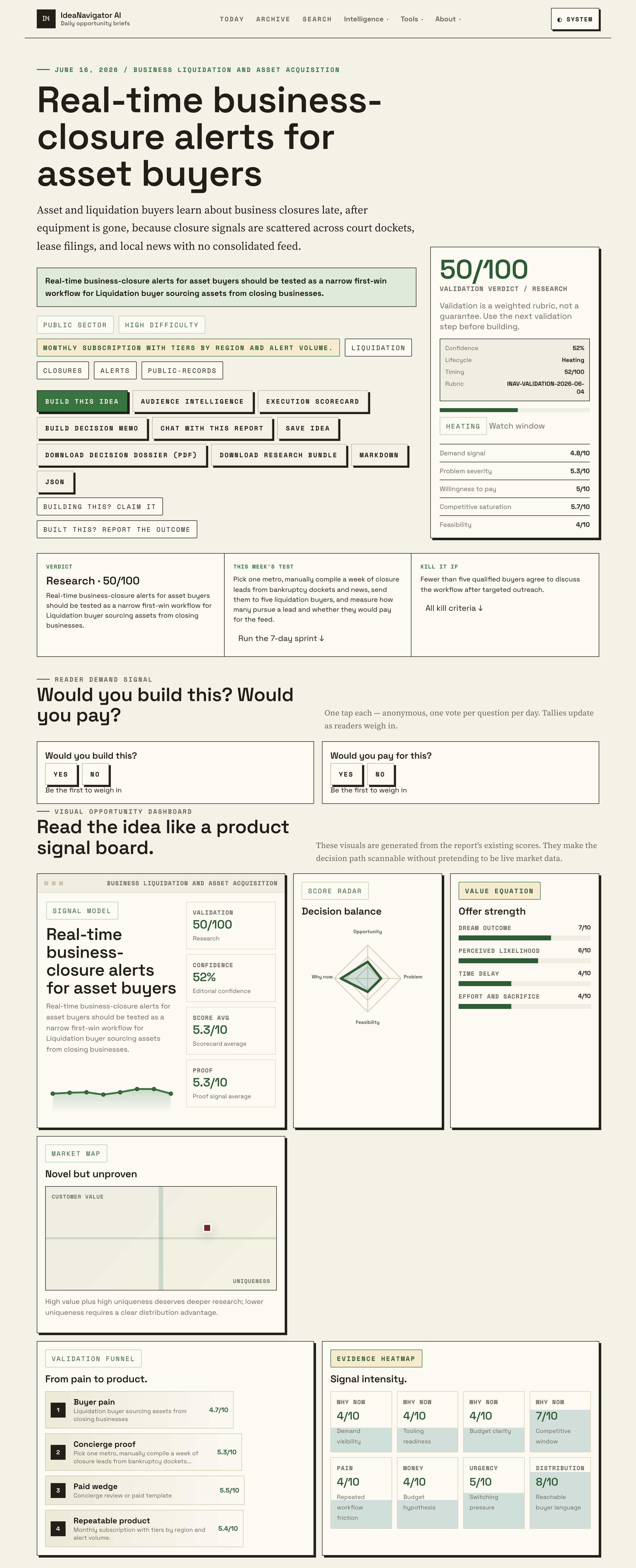
Liquidation buyers can now leverage real-time alerts on business closures to identify assets sooner. This approach, tested through manual curation, aims to streamline asset sourcing and improve market efficiency.
Liquidation buyers are beginning to test a new approach that delivers real-time alerts on business closures, potentially transforming how they source assets from closing companies. This development aims to address longstanding delays caused by scattered information sources and could significantly improve market efficiency for asset acquisition.
The concept involves creating a manual, daily alert system that consolidates closure signals from bankruptcy dockets, lease filings, and local news into a single feed. The alerts would be region-specific and include details such as business type, asset value, and closure timeline. The initial testing involves a small-scale pilot where a human scans relevant legal and news sources, then sends curated leads to participating liquidation buyers.
This approach is motivated by the persistent challenge that asset buyers face: late awareness of business closures, often after equipment has been removed or sold. The opportunity arises because, since the pandemic, many records are now electronically filed and accessible, making real-time aggregation feasible for the first time. The model proposes a monthly subscription service with tiered pricing based on region and alert volume, similar to real-time alert systems.
Potential Impact on Asset Sourcing Efficiency
This development could give liquidation and asset buyers a competitive advantage by enabling earlier access to closure information. Faster alerts mean buyers can act sooner, potentially acquiring assets at better prices before they are removed or sold elsewhere. If successful, this model could reshape the asset liquidation market by reducing information delays and increasing transaction speed, ultimately benefiting buyers and sellers alike.
As an affiliate, we earn on qualifying purchases.
Post-Pandemic Rise in Business Closures and Data Accessibility
The idea stems from the increased volume of small-business closures and bankruptcies following the pandemic, which has led to a surge in available legal filings and news reports. Traditionally, these signals are scattered across various sources, making timely detection difficult. The shift to electronic filing and online news coverage now allows for the possibility of real-time data aggregation, which has not been feasible before. Initial testing is focused on a single metro area, with plans to expand if results prove promising.
“The key is consolidating scattered signals into a single, actionable feed that can be delivered daily to buyers.”
— an anonymous researcher
As an affiliate, we earn on qualifying purchases.
Uncertainties in Effectiveness and Market Adoption
It is not yet clear how many buyers will find value in the alerts or whether the manual curation process can be scaled effectively. The actual impact on purchase activity and asset prices remains to be validated through broader testing and user feedback. Additionally, the cost-effectiveness of the subscription model and the potential for automation are still under evaluation.
As an affiliate, we earn on qualifying purchases.
Next Steps for Validation and Expansion
The initial pilot involves compiling a week of closure leads from bankruptcy dockets and news, then distributing these to five liquidation buyers to measure interest and willingness to pay. If the feedback is positive, the plan is to automate parts of the process, expand coverage to additional regions, and refine the alert system for broader deployment. Further validation will determine whether this approach can become a standard tool in asset liquidation markets.
real-time business closure notifications
As an affiliate, we earn on qualifying purchases.
As an affiliate, we earn on qualifying purchases.
Key Questions
How are the alerts generated?
Currently, alerts are manually curated by scanning bankruptcy dockets, lease filings, and local news for closure signals, then compiling relevant information into a daily feed for buyers.
What assets are targeted by these alerts?
The focus is on assets from closing businesses, including equipment, inventory, and other liquidation-ready assets, depending on the region and asset category specified by the buyer.
Can this system be scaled or automated?
Automation is planned for future phases, but initial testing relies on manual curation to validate the concept before investing in technology that can scale the process efficiently.
What is the cost structure for buyers?
The service is proposed as a monthly subscription with tiered pricing based on region and alert volume, but pricing details are still under development.
When will this alert system be available broadly?
If pilot results are favorable, broader rollout could occur within the next few months, with ongoing adjustments based on user feedback and technological improvements.
Source: IdeaNavigator AI
Halloween Picks
halloween
As an affiliate, we earn on qualifying purchases.