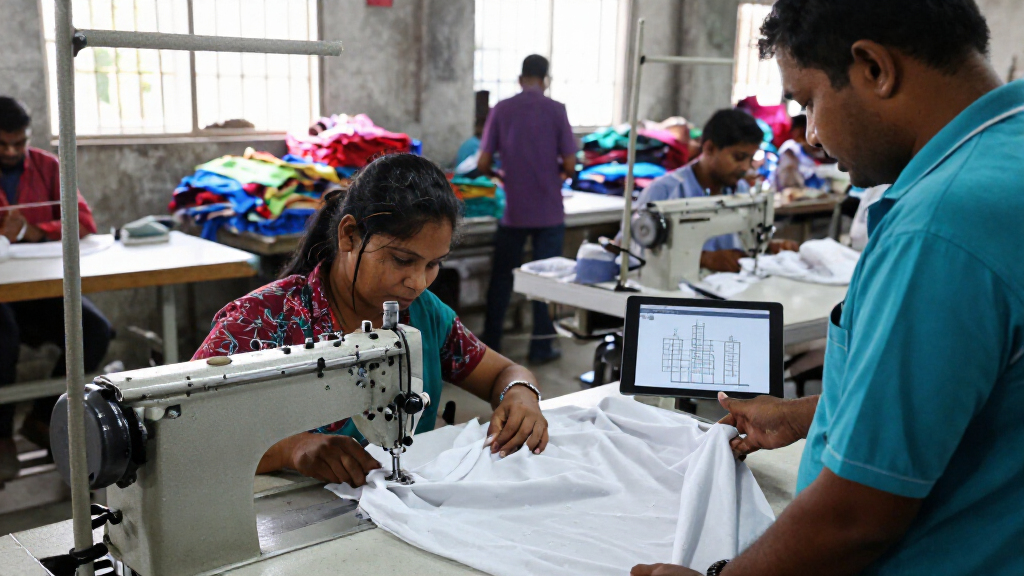
🔍 Read the full analysis: What AI Means For Wages And Jobs In Bangladesh’s Garment Factories on ThorstenMeyerAI.com

Get business pricing on office and shipping supplies
- Business-only prices and quantity discounts
- Tax-exempt purchasing
- Multiple users, one account, clear invoices
TL;DR
Bangladesh’s garment-sector wage board is due to meet again on November 23 after protests escalated and its third meeting was postponed. Workers’ representatives have proposed a 32,000-taka monthly minimum, while owners have not formally submitted a figure; separately, research documents fewer workers on automated production lines, but the immediate effect of AI on jobs and wages remains uncertain.
Bangladesh’s garment-sector wage board is scheduled to meet on November 23, after its November 16 session was postponed and protests over pay spread across industrial areas near Dhaka. Workers’ representatives have proposed a minimum monthly wage of 32,000 taka, while factory owners have not publicly submitted a formal figure; the dispute affects a sector employing about four million people, amid research showing automated production lines can operate with fewer workers.
The current minimum wage is 12,500 taka a month, in force since December 1, 2023. Protesters have demanded 30,000 taka, while the workers’ representative on the wage board formally proposed 32,000 taka, about $257 at the exchange rate cited in the source. Factory owners have not presented an official proposal. The Financial Express reported that owners had discussed a figure of around 15,000 taka before the postponed meeting.
The Bangladesh Garment Manufacturers and Exporters Association and the Bangladesh Knitwear Manufacturers and Exporters Association said in a joint statement that they learned through media reports that workers’ representative Anwar Hossain had fallen ill and been hospitalized. The associations said the employers’ side was prepared to submit its proposal and asked for a replacement meeting date. Five labour alliances representing 55 worker organisations warned that the postponement could send workers the wrong message.
Protests were reported in Gazipur, Savar, Ashulia and Mirpur. Reports differ on the number of factories affected: the Daily Star cited a BGMEA vice-president who said production had stopped at nearly 450 factories, while AFP cited sources estimating about 500 out of the country’s 4,500 garment factories. The Border Guard Bangladesh deployed 42 platoons, and police in Savar said 117 people had been arrested since October 31. On November 18, AP reported that around 20,000 workers from one factory blocked the Dhaka-Aricha Highway; police used tear gas, stun grenades and batons. The number of people injured was not immediately clear.
Pay Dispute Meets Automation
The wage dispute is unfolding in an industry that is both a major source of employment and exposed to pressure over production costs. Workers are seeking a substantial increase from the current minimum, while owners have argued that higher labour costs could weaken Bangladesh’s cost advantage over competitors such as India and Vietnam. The source also points to low prices offered by international buyers and rising energy costs as pressures on manufacturers.
Automation adds a separate concern: whether productivity gains will translate into higher wages, fewer jobs, or changes in the kinds of work available. A 2024 study of factories around Dhaka found automated lines needed 30.58 percent fewer workers, most of them helpers. That finding concerns staffing on those lines; it does not establish how many jobs will be lost across the sector, or that AI itself caused the reductions. For workers, the immediate wage decision and longer-term shifts in factory work are connected by the question of who benefits as production changes.
Popular right now

Apple AirPods Pro (2nd Generation) Wireless Earbuds with USB-C MagSafe Charging Case

Dyson Cyclone V10 Origin Cordless Vacuum

Roborock Qrevo S Pro Robot Vacuum and Mop with Multifunctional Dock
As an affiliate, we earn on qualifying purchases.
The Wage Board’s November Calendar
The wage board process is the immediate setting for the protests. The board had scheduled a third meeting for November 16, when factory owners were expected to respond to the workers’ proposed amount. After that meeting was postponed, the board set November 23 as its next date. Its chairman has said the new minimum wage will take effect on December 1, whatever amount is decided, and workers will receive it with their January 2027 pay.
The industry’s employment profile has also been changing. An ILO working paper calculated from labour force survey data that women’s share of apparel jobs fell from 46.2 percent in 2016–17 to 35.2 percent in 2024. This is a change in women’s share of employment, not a direct count of jobs eliminated by automation. The available material does not establish that AI caused the decline.
The source reports that 98 factories were closed under a “no work, no pay” provision on November 16, and another 24 suspended operations, citing BGMEA sources reported by The Financial Express. On November 17, a worker told AFP, “We want to return to our machines.” The comment reflects the conflict between demands for higher pay and the disruption workers face when factories stop operating.
“We want to return to our machines.”
— A 28-year-old garment worker, speaking to AFP
The Final Wage and Job Impact
The wage board has not announced a final minimum, and factory owners had not formally submitted a figure in the reporting available by November 19. The reported figure of around 15,000 taka was described as a discussion among owners, not an adopted offer. It is also unclear whether the November 23 meeting will produce an agreement.
The scale and consequences of the protests remain incompletely established. Reports gave different estimates of factory shutdowns, and the number of people injured during the November 18 police response was not immediately known. Police in Savar alleged that members of various organisations, including banned groups, had infiltrated the movement; the cited report did not provide evidence for that allegation.
The research on automated lines records lower staffing needs in the factories studied, but the available source does not show how widely those findings apply across Bangladesh’s garment sector. It also does not quantify AI-related job losses, establish that the equipment involved relied on AI, or show whether automation has reduced wages. No international buyer had commented on this round of wage negotiations in the reports cited.
Board Meeting Set for November 23
The next scheduled step is the wage board meeting on November 23. The board’s chairman has said the new minimum is intended to take effect on December 1, with the revised amount included in workers’ January 2027 pay. The board’s decision, if reached, will show how far the parties have moved from the workers’ 32,000-taka proposal and the owners’ reported, unofficial discussion around 15,000 taka.
Protests, factory closures and the effects of the security response may continue to develop in the meantime. Subsequent reporting will need to clarify the final wage, how many factories resume or suspend production, and whether the parties agree on implementation. Longer-term questions about automation will require evidence beyond staffing figures from a limited factory study, including how technology is changing tasks, hiring and pay across the sector.
Key Questions
What is the current minimum wage for garment workers in Bangladesh?
The current sector minimum is 12,500 taka per month, in force since December 1, 2023.
How much are workers asking for?
Workers’ representatives on the wage board proposed 32,000 taka a month. Protesters have also demanded 30,000 taka. The board has not set the final amount.
When will the wage board meet again?
The next meeting is scheduled for November 23, 2026. The November 16 session was postponed after workers’ representative Anwar Hossain fell ill, according to the employers’ associations’ joint statement.
Does the research prove AI is taking garment jobs?
No. A 2024 study of factories around Dhaka found automated lines needed 30.58 percent fewer workers, most of them helpers. The reported finding does not establish that AI caused the difference or quantify job losses across the industry.
When is the new wage expected to take effect?
The wage board’s chairman has said the new minimum will take effect on December 1, regardless of the amount decided, and be paid with workers’ January 2027 wages.
Source: ThorstenMeyerAI.com