

On a Tuesday morning in February, an entire construction project hangs in the balance at Barhorst Bau GmbH & Co. KG. How a general contractor from Osnabrück manages tendering, takt scheduling, and change orders along a single chain of records — and why the most interesting feature is the one that prevents something.

Get office and shipping supplies delivered free — and shop member deals
- Fast, free delivery on millions of items
- Access to Prime Big Deal Days deals on October 6–7
- Prime Video, Amazon Music and more included
The Hour in Which No One Is Allowed to See the Prices
A general contractor from Osnabrück runs tendering, takt scheduling, and change orders along one chain of records — and the most interesting feature is the one that prevents something.
Tuesday, 10:00 a.m. — the blind phase
Company, language, submission time: visible. Prices appear only after the documented opening — the database permits no opening before the submission deadline expires.
The price overview
Gaps between bids are described, never evaluated — the decision stays with the people in the room. The tendering PDF takes two minutes, because it emerges from what happened anyway.
The takt and the completion report
A zone becomes free only when the preceding trade files a completion report with an evidence photo — and construction management approves. Dictated on the move: “Axis D, zone 7, screed poured.”
The rainy day
The delay notice carries the official weather record — named station, distance in kilometers, explicitly a station reading, not a site reading. That honesty is what makes it usable.
The dispute that never became one
The dispute cockpit lays photos, objections, deliveries, weather records, and audio side by side — and shows what is missing. Two gaps were the contractor’s own; he acknowledged half the change order.
“The most pleasant thing is not that we know more. It is that we have to assert less.”
— Ilka Brand, commercial manager, Barhorst Bau (fictional example company)Scenario story: Barhorst Bau is a fictional example company. The story shows the target build-out of Gewerkton; individual features are in beta or under development.
construction tender management software
As an affiliate, we earn on qualifying purchases.
As an affiliate, we earn on qualifying purchases.
Tuesday, 10:00 a.m.: the blind phase
Four people are sitting in the meeting room, and none of them can see what they would like to see. On the screen are eleven bids for the structural shell trade, construction project “Logistics Center South.” Visible: company, the company’s language, submission time, status “submitted.” Not visible: any number at all.
The prices appear only once Ilka Brand, the commercial manager, documents the opening — and the database does not permit an opening before the submission deadline has expired at all. Not as a rule in the quality manual, but as a condition in the data record.
Brand considers this the most important feature Barhorst has ever introduced, and she justifies it unsentimentally: “We are a family business with 180 people. No one has ever accused us of bribery. But we regularly had to explain why the runner-up was not chosen. Now the explanation is in the case file, not in my memory.”
After the opening, a price overview is generated. It only shows indications of the gaps between bids once at least three bids are in, and it describes them without evaluating them — the decision remains with the people in the room. The tendering documentation is produced as a PDF: who was invited, who submitted, who was awarded the contract, and on what grounds. Two minutes of work, because the document emerges from what happened anyway.
construction project documentation tools
As an affiliate, we earn on qualifying purchases.
As an affiliate, we earn on qualifying purchases.
The chain begins before the excavator
Barhorst maintains the bill of quantities in the open exchange format that is standard in the German market, and links the line items to the packages that go out to the subcontractors. This gives every later task, every defect, every measurement a reference upward — all the way to the line item from which an invoice line will eventually emerge.
What this means in day-to-day work only becomes visible in the fourth month. The drywall company reports a work item complete, the measurement is generated from a reading in the calibrated plan and flows into the measurement line as a suggestion — not as a fact. A person confirms. Only then does it become an interim payment item, and only then does anything head toward accounting. Nothing in this workflow becomes binding without approval; that is the point where the platform differs from an automation promise.
weather delay tracking tools for construction
As an affiliate, we earn on qualifying purchases.
As an affiliate, we earn on qualifying purchases.
The takt and the completion report
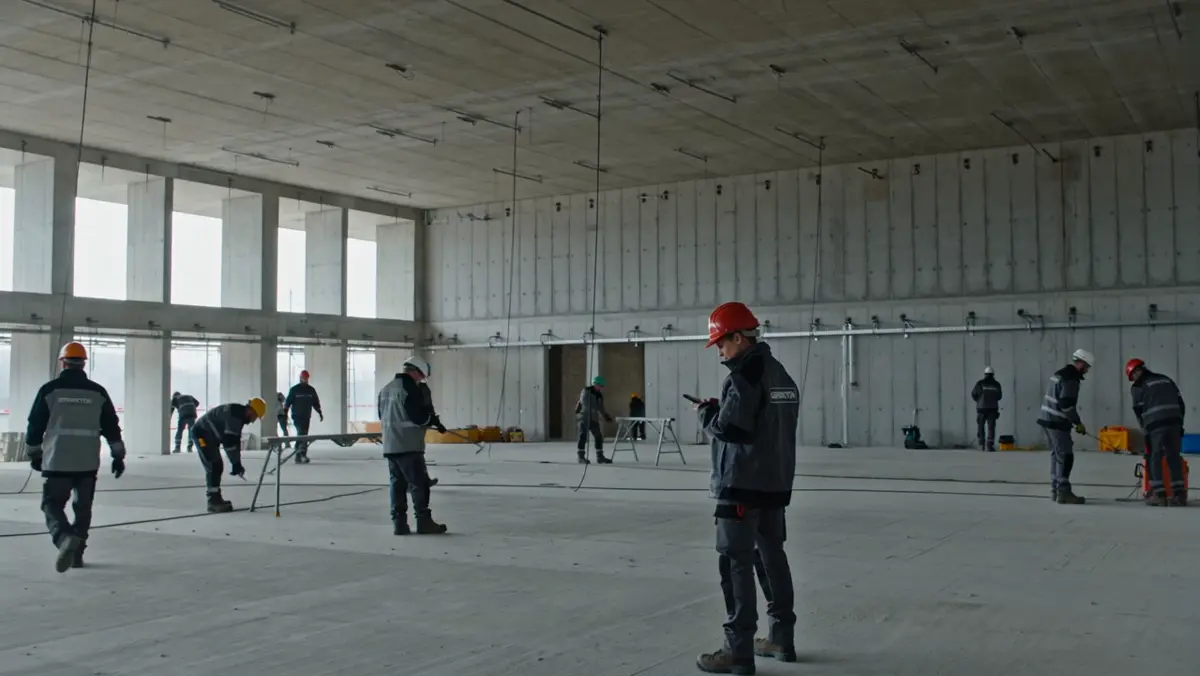
On the construction site, foreman Kemal Yildiz runs the takt board. Eighteen takt zones, six trades, one rhythm he can operate with gloves on. A zone does not become free because a deadline expires, but because the preceding trade files a completion report with an evidence photo — and the completion report is a suggestion, not a self-service button. The construction management approves.
Yildiz dictates his documentation on the move. “Axis D, zone 7, screed poured.” After that sentence, visible clocks start running: readiness for covering, formwork stripping deadlines, waiting times that are building physics rather than administrative deadlines. When two trades are working in the same room in the same week, the platform points this out and recommends photos — not as a prohibition, but because that is exactly where damage occurs.
The 27 content languages are not a marketing argument at Barhorst, but an operational necessity: crews working on the logistics center speak German, Polish, and Romanian. Every instruction arrives in the language in which it will be understood; every report comes back the way it was spoken, and the original remains the evidence.
dispute resolution software for construction projects
As an affiliate, we earn on qualifying purchases.
As an affiliate, we earn on qualifying purchases.
The rainy day that was worth 40,000 euros
On November 3, it rains for seven days. The facade work grinds to a halt, the interior fit-out slips, and the client asks about the handover date.
In practice, delay notices rarely fail because of the process itself, but because of the proof of weather conditions. Barhorst attaches to the notice the weather record from the official open data holdings of the German Weather Service; the platform names the assigned station and its distance in kilometers, and puts next to it what that means — a station reading, not a site reading. It is precisely this honesty that makes the record usable: it claims no more than it shows.
The platform computes the schedule consequences as an estimate, not a verdict. On the client’s side, this produces a report that every participant reads in their own language, with a note stating which version is authoritative. Brand says the discussion with the client lasted twenty minutes instead of two meetings. “We did not prevail because we were louder. We had the chronology, and it was verifiable.”
The dispute that never became one
In January, things get uncomfortable. A facade subcontractor demands a change order for work that Barhorst considers part of the contract and the subcontractor considers additional.
For this case, the dispute cockpit lays the evidence side by side: photos with before and after phases, formal objections, proofs of delivery, weather records, the audio track from the jour fixe, timestamp anchors. It also shows what is missing — five fixed gap rules, no AI, no percentage scores, no invented deadline lengths. In this case, an after photo and the attendance note for a meeting were missing.
Neither could be reconstructed after the fact. That is the uncomfortable half of the truth: a tool that shows gaps also shows your own. Barhorst acknowledged half of the change order and ended the conversation after 40 minutes. Brand considers this the better outcome: “We used to argue because both sides believed they were right. Now both sides see the same thing.”

Had it escalated, the end result would have been a handover package: an archive with a directory and hash register, explicitly labeled as evidence material and without any legal assessment — plus a viewer that the opposing party can open offline and check for themselves. A piece of evidence the other side can recalculate is worth more than one you have to take on faith.
What remains of the software
Barhorst now uses all parts of the house, without anyone in the company keeping the names apart. The field app is the foremen’s tool. The browser environment is the place where construction management and the planning office bring together plans, revisions, and — where no model existed — the self-captured existing geometry. The cloud part keeps the data where the client wants it and opens the interfaces for the company’s own IT, which picks up key figures in the evening.
Added to this are the peripheral services: onboarding support during the first quarter, so that the switchover does not fail on a single crew; training runs for new site managers, because Barhorst hires three every year; an analytics access in which the company compares its own projects against each other — change-order rate, defect density per trade, time until feedback. For trades that Barhorst rarely awards, purchasing pulls template packages from the template library instead of writing them from scratch.
Responsibility does not end with handover; it changes: the building moves into the operations phase, with deadlines derived from the actual acceptance dates, inspection cycles for the technical systems, and a reporting channel for the client — for a general contractor, this is the phase in which defect notifications reach him, and they now reach him with a reference to a documented case instead of as a letter. And when, years later, everything has gone quiet, the project moves into the archive: read access, chain of evidence intact, stored immutably, at a fraction of the price of an active project. Barhorst pays for that because the alternatives — keep paying for everything, or export and safeguard it themselves — are both worse.
Ilka Brand sums it up at a point where most software stories would end: “The most pleasant thing is not that we know more. It is that we have to assert less.”
Transparency: Gewerkton is a product from the publishing house of this publication’s publisher.
[Powered by Thorsten Meyer AI](https://thorstenmeyerai.com/)Learn more about Gewerkton and its lines: Field, Studio and Cloud.
Fall Picks
fall essentials
As an affiliate, we earn on qualifying purchases.