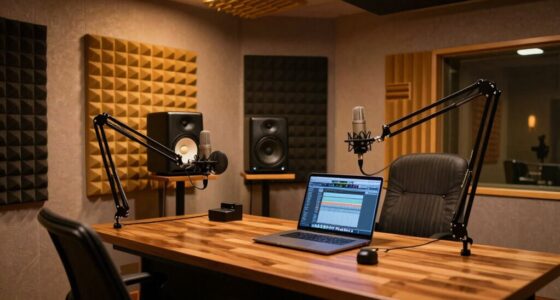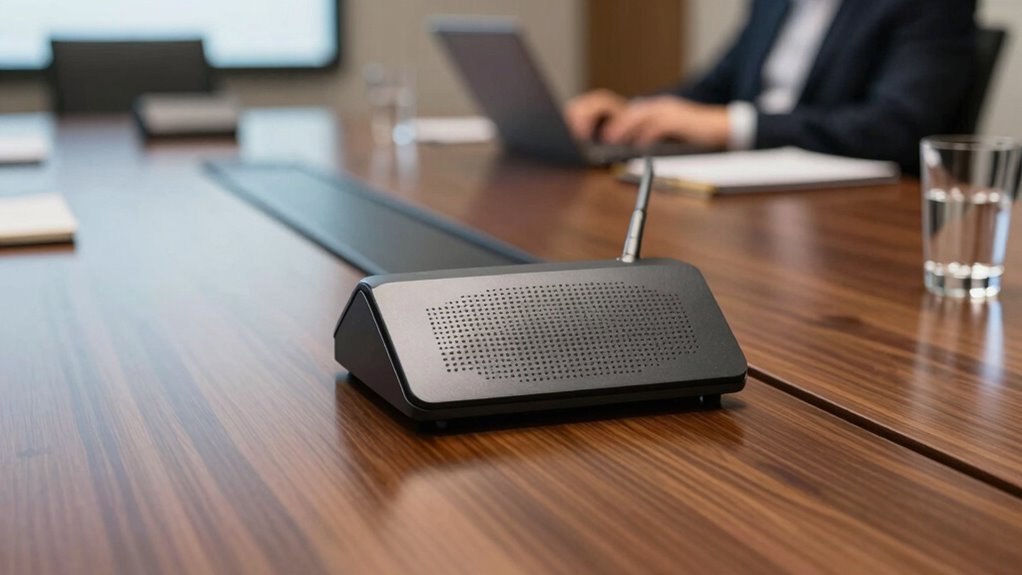

Good call quality relies on proper microphone placement, environmental awareness, and sound technology—not just the camera. Keep the mic directed toward your mouth and avoid blocking it. Choose quiet, enclosed spaces to reduce background noise, and consider devices with noise-canceling features. Adjust microphone sensitivity settings if needed. These steps considerably improve sound clarity and reduce muffling or echo. For tips on optimizing your speakerphone setup, explore more about how environment and technology influence call quality.

Get business pricing on office and shipping supplies
- Business-only prices and quantity discounts
- Tax-exempt purchasing
- Multiple users, one account, clear invoices
Key Takeaways
- Microphone placement and positioning are crucial for clear voice pickup during speakerphone calls.
- Background noise can interfere with microphone clarity, reducing overall call quality.
- Proper environmental setup, like quiet surroundings, enhances microphone performance.
- Adjusting microphone sensitivity and using noise-canceling technology improves sound clarity.
- Good call quality depends more on microphone techniques and environment than on the device’s camera.
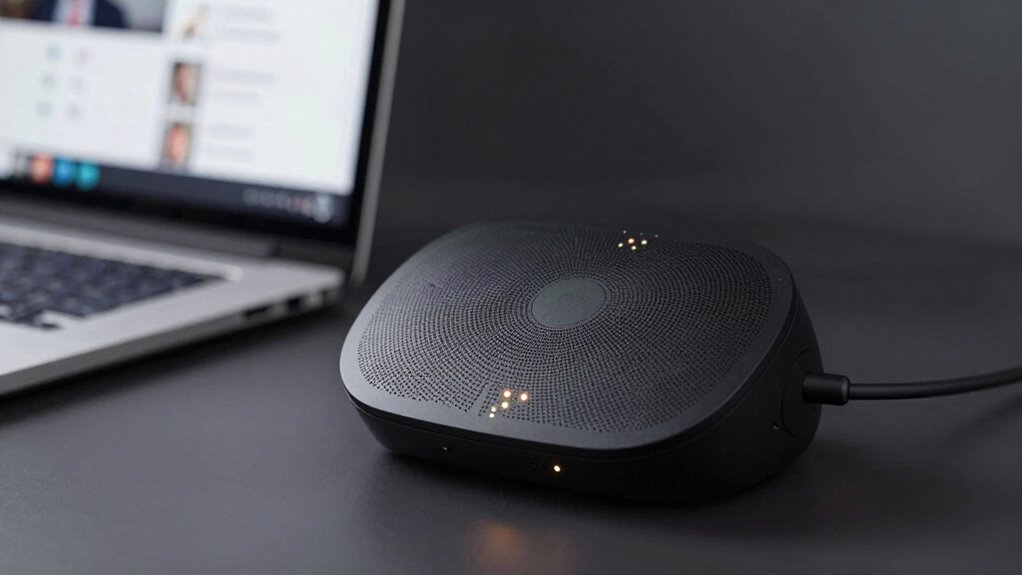
When using a speakerphone, understanding how the microphone picks up sound is essential for clear communication. The microphone’s ability to capture your voice accurately directly influences voice clarity during calls. If the microphone isn’t positioned properly or if it’s affected by surrounding factors, your words can become muffled or hard to understand. This can lead to frustration on both ends of the call, especially if your message doesn’t come across clearly. To improve voice clarity, it’s important to be mindful of how the microphone functions and how your environment impacts sound pickup.
One of the biggest challenges in speakerphone setups is background noise. When there’s a lot of ambient sound—like chatter, music, or street noise—the microphone may pick up these sounds along with your voice. This results in a cluttered audio feed that makes it difficult for the other person to focus on what you’re saying. To combat this, many modern speakerphones are equipped with noise-canceling microphones. These devices use algorithms to filter out background noise, allowing your voice to stand out more prominently. However, even with these features, the placement of the microphone matters. If it’s too far from you or obstructed, your voice can become less distinct, and background noise may become more prominent.
Positioning is critical for ideal microphone pickup. When you’re on a call, make sure the microphone is directed towards your mouth and not blocked by your hands or objects. Keeping a consistent distance—usually a few inches from your mouth—helps maintain voice clarity. If the microphone is too close, it might cause distortion or popping sounds, but if it’s too far, your voice will sound faint and more susceptible to noise interference. Adjusting the microphone’s position or choosing a device with a flexible or adjustable mic can make a significant difference in call quality.
Additionally, your environment plays a role in how well the microphone picks up sound. Quiet, enclosed spaces reduce background noise and improve voice clarity. Conversely, open or noisy environments can overwhelm the microphone, making it harder for others to hear you clearly. Using soft furnishings, closing windows, or moving to a quieter area can help create a better acoustic setting for your calls. Being aware of microphone placement and environmental factors ensures your voice remains clear and comprehensible during calls. Proper microphone positioning and understanding environmental effects are key to achieving optimal call quality. Improving microphone sensitivity settings, when available, can also enhance sound pickup in various environments. Paying attention to environmental noise and its effects can significantly impact overall call quality. Additionally, selecting devices with advanced microphone technology can further improve your experience in challenging environments.
noise cancelling speakerphone microphone
As an affiliate, we earn on qualifying purchases.
As an affiliate, we earn on qualifying purchases.
Frequently Asked Questions
How Does Microphone Placement Affect Call Quality?
Microphone placement greatly impacts your call quality because it affects microphone sensitivity and how well it picks up your voice. If placed too far, your voice may sound faint, and background noise increases. Poor placement can also cause acoustic echo, disrupting clarity. Keep the mic close and unobstructed, ensuring it captures your voice clearly while minimizing echo and background noise for better calls overall.
Can Background Noise Be Completely Eliminated During Calls?
Imagine you’re on a call in a busy café. While echo cancellation and adjusting microphone sensitivity help, completely eliminating background noise is tough. These features reduce distractions, but some sounds may still slip through. Background noise can’t be entirely eradicated, but good microphones and smart tech considerably improve clarity. You can minimize it enough for your conversation to stay clear, even in noisy environments.
What Are the Best Settings for Speakerphone Microphones?
You should set your speakerphone microphone for reliable voice recognition and audio clarity by adjusting sensitivity settings and enabling noise suppression features. Use the automatic gain control (AGC) if available, to balance volume levels, and select noise-canceling options to reduce background sounds. Regularly test and fine-tune these settings during calls to guarantee your voice stays clear, making communication smoother and more effective.
How Does Distance From the Speaker Impact Mic Pickup?
Your voice can be lost in the noise if you’re too far from the speaker, almost like shouting into a canyon. Distance impacts mic pickup by reducing voice clarity and increasing echo, making it harder for the microphone to pick up your voice properly. To guarantee clear calls, stay within a suitable range, activate echo cancellation, and keep the microphone close enough so your voice sounds natural and sharp.
Are External Microphones Better Than Built-In Speakerphone Mics?
External microphones are generally better than built-in speakerphone mics because they often feature enhanced wireless connectivity and higher microphone sensitivity. This means you get clearer, more reliable audio, especially in noisy environments. With an external mic, you can position it closer to your mouth, reducing background noise and improving call quality. Plus, advanced wireless options provide seamless connectivity, ensuring your calls stay crisp and uninterrupted.
adjustable microphone for conference calls
As an affiliate, we earn on qualifying purchases.
As an affiliate, we earn on qualifying purchases.
Conclusion
In the end, understanding speakerphone mic pickup is like tuning a musical instrument—you need the right focus and positioning to hit the perfect note. When your mic captures sound clearly, your calls become as smooth as a well-played melody. So, pay attention to how your microphone picks up your voice, and you’ll find your conversations are clearer and more effective. Remember, good audio quality isn’t just about the camera; it’s about making sure your voice gets through loud and clear.
best speakerphone with noise reduction
As an affiliate, we earn on qualifying purchases.
As an affiliate, we earn on qualifying purchases.
microphone positioning accessories
As an affiliate, we earn on qualifying purchases.
As an affiliate, we earn on qualifying purchases.
Evergreen bestsellers Picks
bestsellers
As an affiliate, we earn on qualifying purchases.