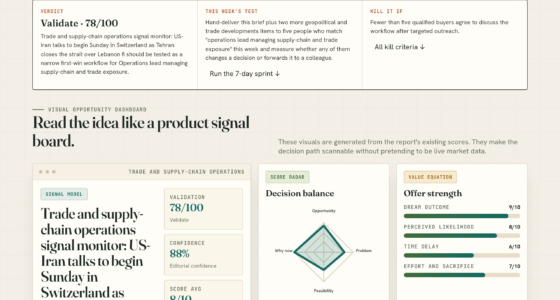
📊 Full opportunity report: Auto Signal Monitor: The EU Law Putting Cameras In Every New Car on IdeaNavigator AI — validation score, market gap, and execution plan.
TL;DR
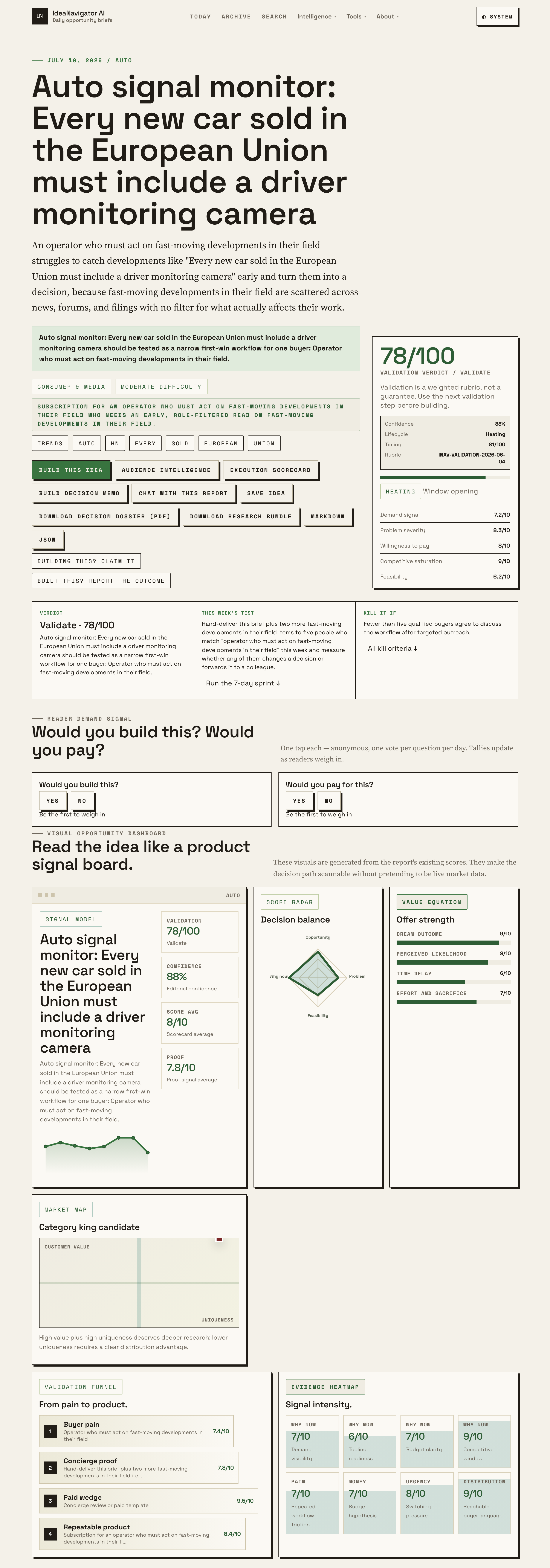
The supplied IdeaNavigator AI brief says every new car sold in the EU must include a driver monitoring camera, but it gives no regulation, date, or official confirmation to substantiate that claim. Its actual development is a proposed monitoring service that would track industry signals and turn relevant items into short decision briefs.
IdeaNavigator AI has proposed a service to flag fast-moving developments in the auto industry, using the claim that every new car sold in the European Union must include a driver-monitoring camera as its example. The brief does not identify an EU law, official announcement, or implementation date, so it does not establish that such a requirement is in force.
The proposed service, called an auto signal monitor in the brief, would watch Hacker News and similar feeds for industry developments, filter them for a particular user’s role, and produce short updates on what changed, why it matters, and what action might follow. The intended audience is described broadly as operators who need to respond to fast-moving developments in their field.
IdeaNavigator AI says the camera claim surfaced on Hacker News with an 88/100 signal. The brief does not define that score, identify the post, or provide a link to an underlying regulation or official EU source. The number therefore describes the brief’s assessment of the signal; it does not verify the legal claim or establish its reach.
The proposed validation is to deliver this brief and two other industry updates to five prospective users during one week, then assess whether any recipient changes a decision or forwards an item to a colleague. The brief suggests subscriptions as a possible business model, but reports no completed customer interviews, test results, paying users, or product launch.
How Car Teams Could Use Alerts
If built and validated, a role-filtered monitoring service could help people working in automotive businesses notice regulatory or market developments sooner than they might through a general roundup. The proposed value is not simply collecting links: it is connecting an update to a specific job and outlining a possible response. Whether users would act on these briefs, or pay for them, has not been demonstrated.
The camera example makes careful verification especially relevant. A claim about a requirement for every new car sold in the EU could affect product planning, compliance work, supplier discussions, and customer communications. But those consequences depend on what the law actually requires, which vehicles it covers, and when it applies. The brief supplies none of those details, so readers should not treat its headline claim as confirmed regulatory guidance.
From Industry Signal to Brief
The proposal starts from a problem identified by IdeaNavigator AI: relevant developments are spread across news, forums, and filings, and generic summaries may not tell a particular operator what requires attention. Its suggested workflow is to monitor feeds, apply a role-based filter, and turn selected items into concise decision briefs.
The brief frames the idea as a narrow first test, rather than documenting an established monitoring product. It names Hacker News as the place where the camera claim appeared and describes similar feeds as potential inputs. It does not identify additional feeds, explain how items would be checked against primary documents, or provide evidence that the EU camera requirement has been adopted.
No date, regulation number, EU institution, or official statement accompanies the claim. Without those details, the available information cannot establish whether it refers to a binding rule, a proposal, an existing feature in some vehicles, or a misunderstanding of another requirement. The precise status and scope remain unverified.
The Camera Requirement Lacks a Citation
The key unresolved point is whether EU law actually requires a driver-monitoring camera in every new car sold in the bloc. The brief gives no legal text, adoption date, effective date, vehicle categories, or explanation of what counts as a driver-monitoring camera. It also does not distinguish a camera requirement from any separate driver monitoring or safety-system obligation.
The status of the proposed service is also unclear. No working product, feed coverage, filtering method, accuracy measure, or test outcome is described. The 88/100 signal score has no stated scale or methodology, and the five-person validation is presented as a plan, not a completed study.
A Five-Person Product Test
IdeaNavigator AI proposes delivering three briefs to five people matching its target user description during a single week. It plans to look for evidence that recipients change a decision or share an item with a colleague. The brief does not say that the test has begun, provide a schedule, or report results.
For the camera claim, the next useful confirmation would be a link to the relevant EU legal text or an official announcement that establishes the rule’s status, scope, and timeline. Until such documentation is identified, the claim should be treated as unverified. The proposed monitor’s usefulness and subscription potential likewise remain open pending the user test.
Source: IdeaNavigator AI
Key Questions
Is a driver-monitoring camera required in every new EU car?
The supplied brief makes that claim but gives no regulation or official confirmation. Its legal status and scope are not established by the information provided.
What is the auto signal monitor?
It is a proposed service that would track industry feeds, filter developments for a user’s role, and produce short briefs about changes and possible actions.
Has the monitoring service launched?
The brief describes an MVP idea and a planned test with five prospective users. It does not report a launch or completed validation.
What does the 88/100 score measure?
The brief calls it a signal score for the Hacker News item, but does not explain the scoring method or what the number represents.
Source: IdeaNavigator AI