
📊 Full opportunity report: Liquid vs Air Cooling for 24/7 Inference Rigs on ThorstenMeyerAI.com — validation score, market gap, and execution plan.

Get office and shipping supplies delivered free — and shop member deals
- Fast, free delivery on millions of items
- Access to Prime Big Deal Days deals on October 6–7
- Prime Video, Amazon Music and more included
TL;DR
For 24/7 AI inference rigs, air cooling generally offers greater reliability, lower cost, and quieter operation than liquid cooling. Liquid coolers excel in handling high thermal loads but require more maintenance and have limited lifespan.
For continuous AI inference systems running 24/7, air cooling is generally the preferred choice over liquid cooling due to its simplicity, reliability, and lower total cost of ownership, according to industry analysis.
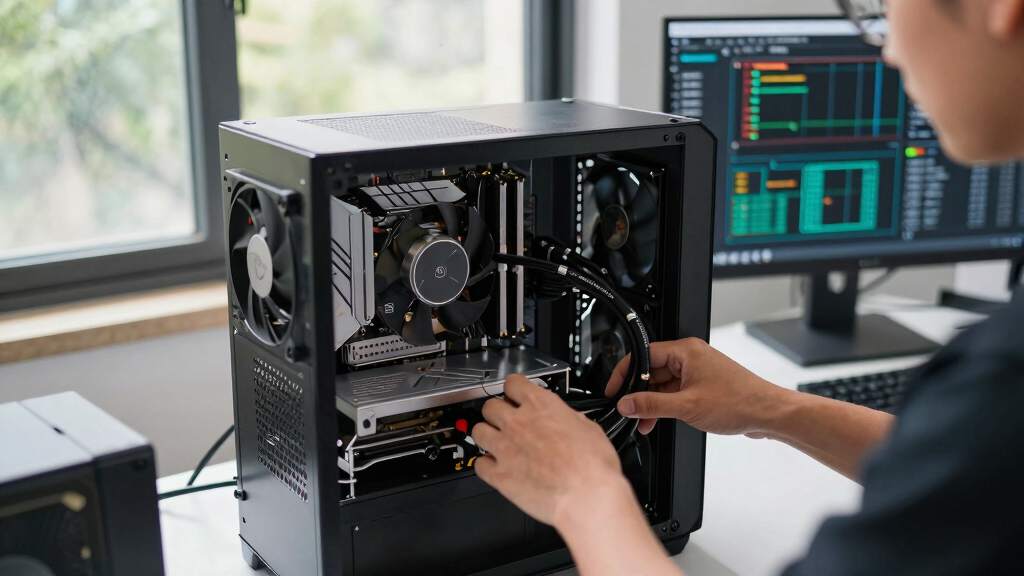
Most AI inference rigs operate unattended for extended periods, making reliability a critical factor. High-quality air coolers, such as dual-tower designs, have only one moving part—the fan—and are less prone to failure compared to sealed liquid coolers, which rely on pumps and sealed loops with multiple components that can degrade over time.
While liquid cooling, specifically all-in-one (AIO) units, can offer higher thermal headroom, they introduce potential points of failure like pump failure, leaks, and seal degradation, with typical lifespan of 5–7 years. These units are more expensive upfront and in maintenance, with total ownership costs often 2–3 times higher than air cooling over the system’s lifespan.
In terms of noise, quality air coolers often operate more quietly under sustained loads, as they lack the constant pump hum characteristic of AIOs. Maintenance for air coolers is minimal—mainly dust removal and occasional thermal paste reapplication—whereas AIOs require monitoring and potential replacement of the entire unit if the pump fails.
Performance-wise, high-end air coolers can dissipate 200–250W, sufficient for most workstation CPUs under continuous load, rivaling mid-sized AIOs. However, for CPUs with very high thermal output or overclocked chips exceeding 360W TDP, large AIOs provide better thermal headroom and can handle sustained workloads more effectively.
Liquid vs air
for a 24/7 inference rig.
For an always-on machine the question isn’t “which cools better” — it’s which one still works in three years without you thinking about it. That reframing makes air the default for most rigs. Answer three questions in Part 2 to find yours.
- Nothing to fail — fan swaps in minutes
- Lasts a decade+; lower total cost
- Quieter floor — no pump hum (~40–45 dBA)
- Trivial maintenance — wipe & repaste
- Tall — can block RAM, dumps heat in case
- Best headroom — ~360W TDP sustained
- Compact block — fits tight cases, clears RAM
- Exports heat out the radiator & room
- Pump fails at 5–7 yrs; replace whole unit
- Costs 2–3× more over its life; pump hum
- You run it 24/7 and want set-and-forget.
- Your CPU is mainstream-to-high-end (or power-capped).
- A big tower fits your case.
- You value lower cost and a quieter floor.
- Your CPU is too hot for air under sustained all-core load.
- A big tower won’t fit (compact / multi-GPU case).
- You need to export heat out of a warm room.
- RAM clearance is tight.
Why Reliability and Cost Matter for Continuous AI Systems
Choosing the right cooling method impacts the long-term operation, maintenance costs, and reliability of AI inference rigs. For unattended, long-term use, air cooling’s simplicity and durability often outweigh the thermal advantages of liquid cooling. This decision can influence the total cost of ownership and system uptime, critical factors for AI deployment in production environments.
high quality air CPU cooler for 24/7 operation
As an affiliate, we earn on qualifying purchases.
As an affiliate, we earn on qualifying purchases.
Cooling Choices in the Evolution of AI Workstations
Traditional gaming and high-performance PCs have favored liquid cooling for its aesthetic appeal and marginal thermal benefits. However, AI inference rigs operate under different priorities—stability, longevity, and minimal maintenance. Industry analysis indicates a shift toward air cooling for these systems, especially as high-quality air coolers now rival AIOs in performance and surpass them in reliability. The trend reflects a broader understanding that, for continuous operation, simplicity often provides more value than marginal gains in thermal capacity.
"For 24/7 inference rigs, reliability and low maintenance are paramount. Air cooling offers a proven, durable solution that minimizes downtime."
— Thorsten Meyer, AI hardware expert
liquid cooling all-in-one (AIO) for high thermal loads
As an affiliate, we earn on qualifying purchases.
As an affiliate, we earn on qualifying purchases.
Long-Term Performance and Failure Rates of Liquid Coolers
While modern AIOs are generally reliable, there is limited data on their long-term performance in continuous operation over many years. The actual lifespan of pumps and seals in real-world AI inference environments remains somewhat uncertain, and failure modes like leaks, although rare, can cause significant damage. Further longitudinal studies are needed to confirm the durability of liquid coolers in these specific use cases.
quiet 120mm or 240mm PC fan for continuous use
As an affiliate, we earn on qualifying purchases.
As an affiliate, we earn on qualifying purchases.
Monitoring and Future Trends in Cooling for AI Workstations
Next steps include ongoing performance monitoring of liquid coolers in AI rigs, with manufacturers possibly improving pump longevity and seal durability. Users are advised to consider redundancy or regular maintenance schedules if opting for liquid cooling. Additionally, advancements in passive cooling and hybrid solutions may influence future choices, but currently, air cooling remains the most reliable for long-term, unattended operation.
reliable CPU cooler for AI inference rigs
As an affiliate, we earn on qualifying purchases.
As an affiliate, we earn on qualifying purchases.
Key Questions
Is liquid cooling necessary for AI inference rigs?
Not generally. Most high-quality air coolers can handle the thermal loads of typical AI inference CPUs under continuous operation, offering greater reliability and lower maintenance.
How long do AIO liquid coolers last in continuous use?
Manufacturers typically warranty AIOs for 5–6 years, but the actual lifespan may vary. Pump failure and seal degradation are common failure modes after several years of continuous operation.
What are the main advantages of air cooling for 24/7 AI systems?
Air cooling offers simplicity, fewer failure points, lower cost, quieter operation, and easier maintenance, making it ideal for unattended, long-term workloads.
Can I upgrade from air to liquid cooling later?
Yes, but it involves system modifications and additional costs. For most users, choosing the optimal cooling method at the outset is preferable given the reliability considerations.
Source: ThorstenMeyerAI.com
Fall Picks
fall essentials
As an affiliate, we earn on qualifying purchases.